
Finance
Waller’s 21 Words: What a Half-Point Fed Hike Could Mean Now

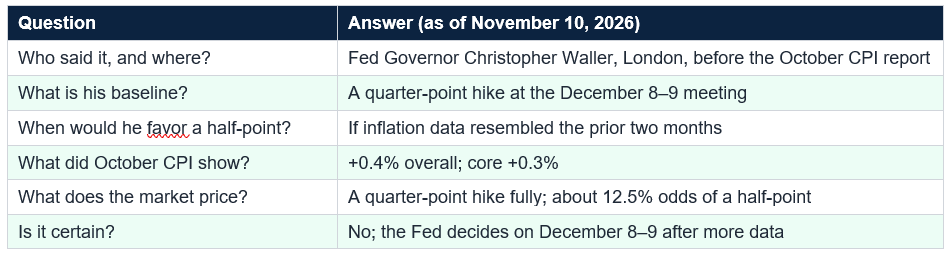
Waller leaning toward a quarter-point hike at the December 8–9 meeting; a half-point hike “should be considered” if October inflation resembled the prior two months (core around 0.3% or more); the sentence at the heart of the headline is 21 words long (my count). The data and market: October CPI +0.4% month over month, core +0.3% (as in August and September); 2-year yield up 18+ basis points to 4.733%; 10-year back at about 5% (24-year highs in October); 30-year 5.35%; traders priced a quarter-point December hike fully (about 85% beforehand) and about 12.5% odds of a half-point; the Fed hiked a quarter point in September and held in October with two dissents; Logan wants at least two more hikes. My arithmetic: the odds imply an expected December hike of about 28 basis points (up from about 21 before the speech); a quarter-point hike would lift the federal funds range from 3.75%–4.00% to 4.00%–4.25% and a half-point to 4.25%–4.50%; a quarter-point costs about $125 a year per $50,000 of variable debt; the Shiller CAPE of 41 implies a 2.4% earnings yield against a 5% 10-year Treasury.
A Motley Fool article the same day focused on one 21-word sentence from the speech and argued it could make a year-end stock rally harder. It is a catchy framing, and there is something to it, but what Waller said was conditional, the market had already priced most of a December hike and the effect on stocks depends on more than one governor’s speech. This guide walks through the facts, the numbers and the questions to ask.
It is also not quite what the Fool framing implies. The article says Waller favors a hike even if October inflation was softer; in the speech text as quoted elsewhere, he said that even if inflation improved as he expected he was leaning toward a 25-basis-point increase, and that 50 basis points should be considered if the data looked like the prior two months. So the baseline is a quarter-point hike, with a half-point a conditional possibility, not a plan. A footnote notes the views are his own.
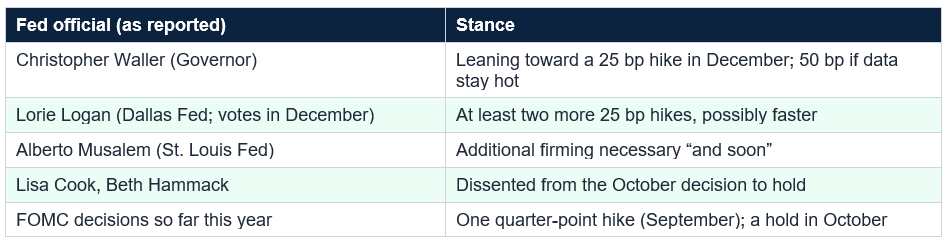
Other officials sound similar. St. Louis Fed President Alberto Musalem said additional firming will be necessary and soon, and Dallas Fed President Lorie Logan, who votes on the December decision, said the committee needs at least two more quarter-point increases, perhaps at a quicker pace, per Bloomberg. Waller described the economy as growing at a healthy pace with a solid labor market. The backdrop is strong growth, stubborn inflation and a committee debating how fast to move.
Waller (Nov 10): leaning toward a 25 bp hike at the Dec 8–9 meeting; 50 bp “should be considered” if inflation resembles the prior two months. October CPI +0.4% (core +0.3%). 2-year yield 4.733%, 10-year about 5%, 30-year 5.35%. Market: quarter-point December hike fully priced, about 12.5% odds of a half-point.
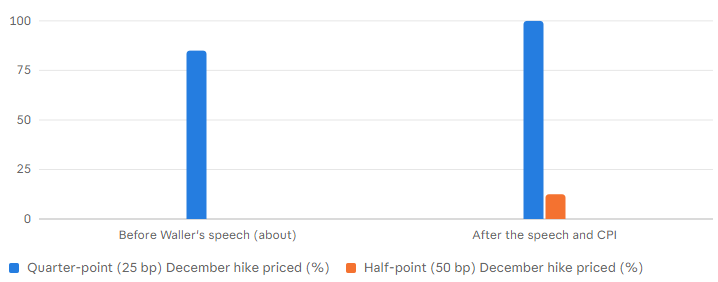
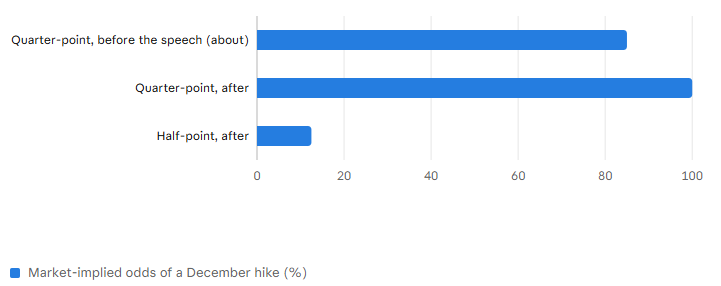
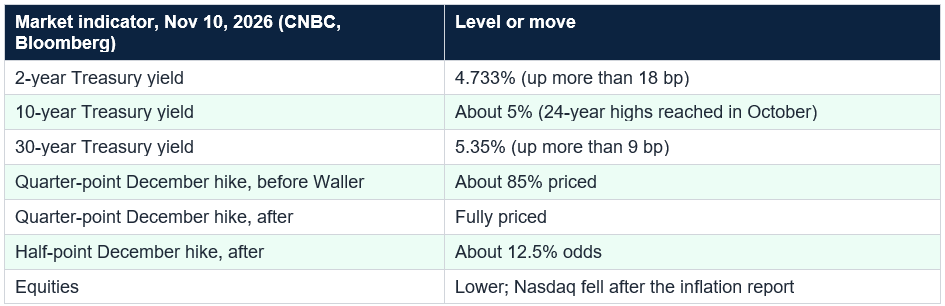
Stocks were lower on Tuesday, and the Nasdaq fell after the inflation report, per TheStreet. Before the speech, swaps priced about an 85% chance of a December quarter-point hike; afterward traders fully priced it, with about 12.5% odds of a half-point, per Bloomberg and CNBC. The market did not take the half-point as a base case, and Bloomberg noted investors did not appear convinced the Fed would deliver one.
That is why the headline may overstate the effect. The Fool notes the market had already been pricing hikes through 2027. What could challenge stocks is not the quarter-point hike itself but the path: a half-point surprise, a faster pace in 2027 or a sense that inflation is not coming down. Logan’s call for at least two more hikes points that way, and traders expect at least one more quarter-point hike next year.
Valuations are high. The Shiller CAPE was above 41 in early October, the highest in about 25 years by one measure, implying an earnings yield of about 2.4% in my arithmetic against a 10-year Treasury near 5%, a gap of about 2.6 points in bonds’ favor, though CAPE is only one yardstick and stocks offer growth that bonds do not. Add AI-spending jitters and a chip-stock sell-off, and the market has less cushion than usual. That is the real basis for concern, rather than 21 words.
The case against is also real: a quarter-point hike is largely priced, the half-point scenario was conditional and the market gave it low odds. Strong growth and a solid labor market can support earnings, and officials will receive one more jobs report and a full slate of inflation data before December 8–9. Nobody can reliably predict year-end returns from one speech. The risk of a bumpy few weeks is real, and the direction is uncertain.
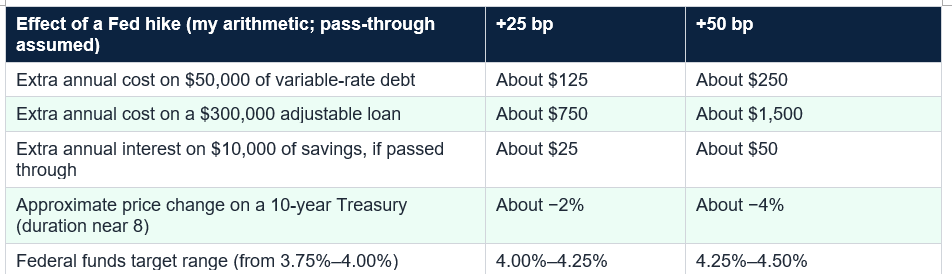
Savers can benefit: if banks pass it through, $10,000 of savings earns about $25 more a year after a quarter-point hike and $50 after a half-point, in my arithmetic, with top online savings at about 4.35% and 52-week Treasury bills about 4.46% in early November (Bankrate, MyMoneyBlog). Bond prices usually fall when yields rise: for a 10-year Treasury with a duration near 8, 25 basis points is a loss of about 2% and 50 basis points about 4%, a rough approximation.
We also do not know the next inflation data, the next jobs report or how the FOMC will vote, or whether energy prices will keep falling, which affected inflation expectations on Tuesday, per CNBC. The scenarios argue for flexibility: keep a cash cushion, avoid excess variable-rate debt and size stock positions so a bad month would not force a bad decision.
Scenario (no probabilities assigned) What it might look like
A simple routine: check the market-implied odds (such as the CME FedWatch tool), the data calendar and your own exposure to rate changes through debt, bonds and stocks, then decide whether your plan should change. For most people with a long horizon and diversified holdings, the answer will be no; for those with variable-rate debt, a large bond allocation or concentrated stock positions, it may be yes.
List your variable-rate debts and their balances, then multiply each by 0.25% and 0.50% to see what a hike would cost per year. If the number is uncomfortable, consider paying that debt down or fixing the rate. Common mistakes include treating one official’s speech as the Fed’s decision, reading a conditional statement as a plan, ignoring what is already priced in, trading on a headline within minutes, forgetting that variable-rate debt will change in cost and assuming a year-end rally or sell-off is certain. The committee votes, and the data before December can change minds.
That could add pressure on stocks, especially with the Shiller CAPE above 41 and bonds yielding 5%, but the move was mostly priced in and the half-point is conditional, so the headline is more dramatic than the facts. For households, a quarter-point hike costs about $125 a year per $50,000 of variable debt and earns about $25 a year on $10,000 of savings if passed through. Watch the data, the December decision and your own exposure, and avoid trading on a single sentence.
In a November 10 speech in London, Fed Governor Waller said he was leaning toward supporting a quarter-point rate increase at the Fed’s December 8–9 meeting, even if October inflation improved as he expected. He added that if October’s CPI looked like the prior two months, with core inflation around 0.3% or more, a half-point hike should be considered. A 21-word sentence about that half-point option is what The Motley Fool’s headline refers to.
Is a half-point rate hike in December likely?
Not according to the market so far. After the speech and a hotter-than-expected CPI report, traders fully priced a quarter-point December hike and put about 12.5% odds on a half-point move, according to CNBC, though Bloomberg said investors did not appear convinced the Fed would go that far. Fed officials will get one more jobs report and more inflation data before the meeting, so the odds could change.
What was the October inflation report?
The consumer price index rose 0.4% in October from September, and core CPI, which excludes food and energy, rose 0.3%, the same as in September and August, according to the sources I found. The Bureau of Labor Statistics said it could not publish a 12-month October figure because it did not collect survey data in October 2025 during a lapse in appropriations. The 12-month rate was 3.7% in September.
Will this hurt the stock market through year end?
It could add pressure, but the facts are less dramatic than the headline. A quarter-point hike was already largely expected, Waller’s half-point comment was conditional and the market moved only modestly toward it. Higher rates matter more when valuations are high, and the 10-year Treasury yield has returned to about 5%. Nobody can reliably predict year-end returns. This is general education, not personal advice.
How do higher Fed rates affect my money?
Variable-rate debt, such as credit cards, home equity lines and adjustable mortgages, tends to get more expensive, while savings accounts and short-term Treasuries may pay a bit more. In my arithmetic, a quarter-point increase costs about $125 a year on $50,000 of variable debt and earns about $25 a year on $10,000 of savings if banks pass it through. Bond prices usually fall when yields rise.
Table of Contents
- What Happened
- The 21 Words, in Plain English
- The Short Answer
- Why the Fed Is Talking About Hikes
- How Markets Reacted
- What Was Already Priced In
- Why Rates Matter for Stocks
- Does This Challenge a Year-End Rally?
- What It Means for Your Money
- Scenarios to Keep in Mind
- What to Watch Before December 8–9
- Common Mistakes
- Conclusion
- Frequently Asked Questions
How the market's December odds moved after Waller and the hot CPI (%)
Market-implied odds (%) by Bloomberg (swaps, about 85% beforehand) and CNBC (quarter-point fully priced; 12.5% odds of a half-point) on November 10, 2026; the pre-speech half-point figure is not given in the sources and is shown as 0; odds change quickly
How the market's December hike odds moved after Waller and the hot CPI (%)
Market-implied odds (%) by Bloomberg (swaps priced roughly 85% for a quarter-point beforehand) and CNBC (quarter-point fully priced; 12.5% odds of a half-point afterward), November 10, 2026; the pre-speech half-point odds were not reported; odds change quickly
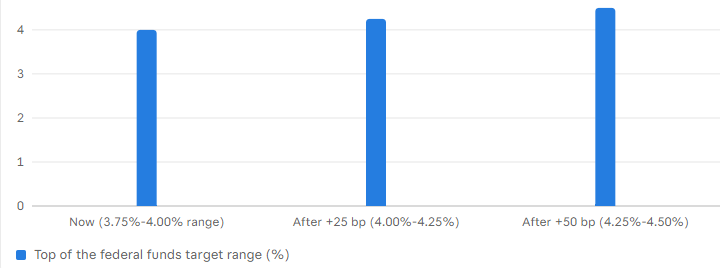
Where rates could go: top of the Fed's target range now vs. after a 25 bp or 50 bp December hike (%)
Upper bound of target range (%) by my arithmetic from the 3.75%-4.00% range set after September's hike (earlier research in this series, not re-retrieved); the Fed decides on December 8-9, 2026; illustration, not a forecast
What Happened
On Tuesday, November 10, Federal Reserve Governor Christopher Waller gave a speech in London at a central bank conference hosted by the Bank of England. He said he was leaning toward supporting a rate increase at the Fed’s next meeting, on December 8 and 9, and that if inflation data stayed hot, a bigger move might be needed. Hours later, October’s consumer price data came in hotter than expected, Treasury yields jumped, stocks fell and traders adjusted their bets.A Motley Fool article the same day focused on one 21-word sentence from the speech and argued it could make a year-end stock rally harder. It is a catchy framing, and there is something to it, but what Waller said was conditional, the market had already priced most of a December hike and the effect on stocks depends on more than one governor’s speech. This guide walks through the facts, the numbers and the questions to ask.
The 21 Words, in Plain English
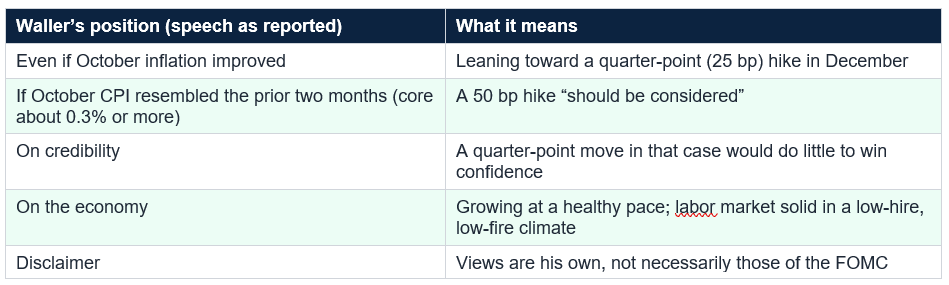
The sentence, 21 words by my count, says that in a particular scenario Waller believes a 50-basis-point hike should be considered at the December meeting. That scenario, according to the speech text quoted by PR Newswire, was October inflation similar to the past two monthly readings, with core CPI around 0.3% or higher. In that case a stronger move may be needed, and a quarter-point would do little to win confidence that the Fed is tackling inflation, according to Bloomberg’s account.It is also not quite what the Fool framing implies. The article says Waller favors a hike even if October inflation was softer; in the speech text as quoted elsewhere, he said that even if inflation improved as he expected he was leaning toward a 25-basis-point increase, and that 50 basis points should be considered if the data looked like the prior two months. So the baseline is a quarter-point hike, with a half-point a conditional possibility, not a plan. A footnote notes the views are his own.
The Short Answer
Fed Governor Christopher Waller said on November 10 that he was leaning toward a quarter-point rate hike in December and that a half-point hike should be considered if inflation data looked like the prior two months. October CPI then rose 0.4% (core 0.3%), the 10-year Treasury yield returned near 5% and traders priced a quarter-point hike as certain with about 12.5% odds of a half-point. It could weigh on stocks, since higher rates pressure expensive markets, but the move was mostly priced in and the half-point scenario was conditional. The December 8–9 decision and the data before it matter more than one speech.
Why the Fed Is Talking About Hikes
The Fed has been tightening, which surprises people who remember rate cuts. It approved a quarter-point hike in September, then passed on a hike in October in a non-unanimous decision: Governor Lisa Cook and Cleveland Fed President Beth Hammack dissented, per CNBC. In my earlier research the target range was 3.75% to 4.00% after September. Inflation was 3.7% year over year in September, October’s monthly figures suggest it has not cooled and Waller warned that earlier energy shocks may keep affecting prices into 2027.Other officials sound similar. St. Louis Fed President Alberto Musalem said additional firming will be necessary and soon, and Dallas Fed President Lorie Logan, who votes on the December decision, said the committee needs at least two more quarter-point increases, perhaps at a quicker pace, per Bloomberg. Waller described the economy as growing at a healthy pace with a solid labor market. The backdrop is strong growth, stubborn inflation and a committee debating how fast to move.
Waller (Nov 10): leaning toward a 25 bp hike at the Dec 8–9 meeting; 50 bp “should be considered” if inflation resembles the prior two months. October CPI +0.4% (core +0.3%). 2-year yield 4.733%, 10-year about 5%, 30-year 5.35%. Market: quarter-point December hike fully priced, about 12.5% odds of a half-point.
How Markets Reacted
The bond market moved most. The 2-year Treasury yield, which closely tracks Fed expectations, surged more than 18 basis points to 4.733%, and the 30-year rose more than 9 basis points to 5.35%, per CNBC. The 10-year returned to about 5%, a level it had touched earlier this month, and it and the 30-year reached 24-year highs in October. The 2-year rose about 4 basis points during Waller’s speech itself, with the rest coming after the hot CPI report.Stocks were lower on Tuesday, and the Nasdaq fell after the inflation report, per TheStreet. Before the speech, swaps priced about an 85% chance of a December quarter-point hike; afterward traders fully priced it, with about 12.5% odds of a half-point, per Bloomberg and CNBC. The market did not take the half-point as a base case, and Bloomberg noted investors did not appear convinced the Fed would deliver one.
What Was Already Priced In
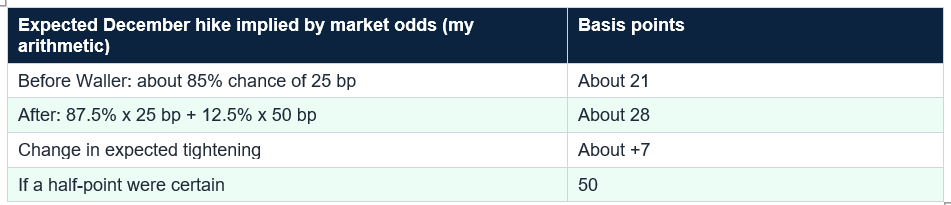
Markets try to anticipate the Fed, so the question is how much surprise is left. In my arithmetic, 85% odds of a 25 bp hike imply an expected December move of about 21 basis points; a fully priced quarter-point plus a 12.5% chance of a half-point implies about 28 (87.5% times 25 plus 12.5% times 50). So the news added about 7 basis points of expected tightening, meaningful but not enormous.That is why the headline may overstate the effect. The Fool notes the market had already been pricing hikes through 2027. What could challenge stocks is not the quarter-point hike itself but the path: a half-point surprise, a faster pace in 2027 or a sense that inflation is not coming down. Logan’s call for at least two more hikes points that way, and traders expect at least one more quarter-point hike next year.
Why Rates Matter for Stocks
Higher interest rates affect stocks in several ways (general knowledge): they raise the return on safer assets, so stocks must offer more to compete; they raise the rate at which future profits are discounted, which hits expensive, growth-oriented stocks hardest; and they raise borrowing costs for companies and consumers. The effect depends on the starting point: when valuations are modest, higher rates matter less, and when they are high, more.Valuations are high. The Shiller CAPE was above 41 in early October, the highest in about 25 years by one measure, implying an earnings yield of about 2.4% in my arithmetic against a 10-year Treasury near 5%, a gap of about 2.6 points in bonds’ favor, though CAPE is only one yardstick and stocks offer growth that bonds do not. Add AI-spending jitters and a chip-stock sell-off, and the market has less cushion than usual. That is the real basis for concern, rather than 21 words.
Does This Challenge a Year-End Rally?
It might, but I would not overstate it. The case for concern is straightforward: a Fed hiking into elevated valuations, a 10-year yield at 5% and hot inflation is a less friendly backdrop for a rally. If more FOMC members sound like Waller, a half-point hike stays in play, as the Fool notes, and Bloomberg called his remarks the strongest argument from a Fed official yet for 50 basis points.The case against is also real: a quarter-point hike is largely priced, the half-point scenario was conditional and the market gave it low odds. Strong growth and a solid labor market can support earnings, and officials will receive one more jobs report and a full slate of inflation data before December 8–9. Nobody can reliably predict year-end returns from one speech. The risk of a bumpy few weeks is real, and the direction is uncertain.
What It Means for Your Money
For households, the effects are practical. A rate hike generally raises the cost of variable-rate debt such as credit cards, home equity lines and adjustable mortgages, because those rates track the policy rate (general knowledge). In my arithmetic, a quarter-point costs about $125 a year on $50,000 of variable debt and a half-point about $250; on a $300,000 adjustable loan, $750 and $1,500. Fixed-rate debt is unaffected, though new loans may be priced higher.Savers can benefit: if banks pass it through, $10,000 of savings earns about $25 more a year after a quarter-point hike and $50 after a half-point, in my arithmetic, with top online savings at about 4.35% and 52-week Treasury bills about 4.46% in early November (Bankrate, MyMoneyBlog). Bond prices usually fall when yields rise: for a 10-year Treasury with a duration near 8, 25 basis points is a loss of about 2% and 50 basis points about 4%, a rough approximation.
Scenarios to Keep in Mind
It helps to think in scenarios without assigning probabilities beyond what the market implies. In one, the next inflation data cool a little and the Fed hikes a quarter point as expected, which may leave markets relieved. In another, inflation stays hot, the half-point becomes real and yields rise further, pressuring stocks and bonds. In a third, data are mixed and the Fed hikes a quarter point but signals more to come. None is certain.We also do not know the next inflation data, the next jobs report or how the FOMC will vote, or whether energy prices will keep falling, which affected inflation expectations on Tuesday, per CNBC. The scenarios argue for flexibility: keep a cash cushion, avoid excess variable-rate debt and size stock positions so a bad month would not force a bad decision.
Scenario (no probabilities assigned) What it might look like
What to Watch Before December 8–9
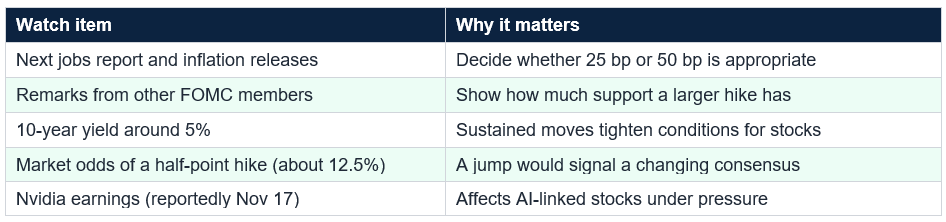
Several items could move the odds: the next jobs report and remaining inflation releases, comments from other FOMC members, how the 10-year yield behaves around 5%, Nvidia’s earnings (reportedly November 17), which could affect AI-linked stocks, and any change in the market’s odds of a half-point hike, now about 12.5%.A simple routine: check the market-implied odds (such as the CME FedWatch tool), the data calendar and your own exposure to rate changes through debt, bonds and stocks, then decide whether your plan should change. For most people with a long horizon and diversified holdings, the answer will be no; for those with variable-rate debt, a large bond allocation or concentrated stock positions, it may be yes.
List your variable-rate debts and their balances, then multiply each by 0.25% and 0.50% to see what a hike would cost per year. If the number is uncomfortable, consider paying that debt down or fixing the rate. Common mistakes include treating one official’s speech as the Fed’s decision, reading a conditional statement as a plan, ignoring what is already priced in, trading on a headline within minutes, forgetting that variable-rate debt will change in cost and assuming a year-end rally or sell-off is certain. The committee votes, and the data before December can change minds.
Conclusion
Fed Governor Christopher Waller’s 21 words, a conditional statement that a 50-basis-point hike should be considered in December if inflation looked like the prior two months, landed on a day when October CPI rose 0.4% and the 10-year Treasury yield returned to about 5%. His baseline is a quarter-point hike at the December 8–9 meeting, which the market now fully prices, with about 12.5% odds of a half-point. In my arithmetic, the news raised expected December tightening from about 21 to about 28 basis points.That could add pressure on stocks, especially with the Shiller CAPE above 41 and bonds yielding 5%, but the move was mostly priced in and the half-point is conditional, so the headline is more dramatic than the facts. For households, a quarter-point hike costs about $125 a year per $50,000 of variable debt and earns about $25 a year on $10,000 of savings if passed through. Watch the data, the December decision and your own exposure, and avoid trading on a single sentence.
Frequently Asked Questions
What did Christopher Waller actually say?In a November 10 speech in London, Fed Governor Waller said he was leaning toward supporting a quarter-point rate increase at the Fed’s December 8–9 meeting, even if October inflation improved as he expected. He added that if October’s CPI looked like the prior two months, with core inflation around 0.3% or more, a half-point hike should be considered. A 21-word sentence about that half-point option is what The Motley Fool’s headline refers to.
Is a half-point rate hike in December likely?
Not according to the market so far. After the speech and a hotter-than-expected CPI report, traders fully priced a quarter-point December hike and put about 12.5% odds on a half-point move, according to CNBC, though Bloomberg said investors did not appear convinced the Fed would go that far. Fed officials will get one more jobs report and more inflation data before the meeting, so the odds could change.
What was the October inflation report?
The consumer price index rose 0.4% in October from September, and core CPI, which excludes food and energy, rose 0.3%, the same as in September and August, according to the sources I found. The Bureau of Labor Statistics said it could not publish a 12-month October figure because it did not collect survey data in October 2025 during a lapse in appropriations. The 12-month rate was 3.7% in September.
Will this hurt the stock market through year end?
It could add pressure, but the facts are less dramatic than the headline. A quarter-point hike was already largely expected, Waller’s half-point comment was conditional and the market moved only modestly toward it. Higher rates matter more when valuations are high, and the 10-year Treasury yield has returned to about 5%. Nobody can reliably predict year-end returns. This is general education, not personal advice.
How do higher Fed rates affect my money?
Variable-rate debt, such as credit cards, home equity lines and adjustable mortgages, tends to get more expensive, while savings accounts and short-term Treasuries may pay a bit more. In my arithmetic, a quarter-point increase costs about $125 a year on $50,000 of variable debt and earns about $25 a year on $10,000 of savings if banks pass it through. Bond prices usually fall when yields rise.
0 Comments
Be the first to share your thoughts on this article.