
Retirement
How Long Does £100,000 Retirement Savings Last by UK Region

From 2.5 years in London to 4.3 years in Northern Ireland and the North East. The regional retirement divide is wider than most savers realise — and for some, a £100,000 pot runs out before a retirement barely begins.
One hundred thousand pounds sounds like a substantial retirement fund. For many UK savers, it represents years of disciplined saving, workplace pension contributions, and the quiet discipline of delayed consumption. But the question of whether £100,000 is enough — or how long it will actually last — is not answered by the number itself. It is answered by where you plan to spend your retirement. This Erneroy.com Research study applies the Pensions and Lifetime Savings Association’s Retirement Living Standards, regional cost data from Key Group’s June 2026 analysis, and retirement savings data from Phoenix Insights to produce the most granular available picture of how long £100,000 lasts across every UK region. The answer ranges from approximately 2.5 years in London to approximately 4.3 years in Northern Ireland and the North East of England. For those relying on £100,000 as their primary retirement nest egg, this regional gap is not a footnote — it is the central fact of retirement planning.
This Erneroy.com Research study applies a consistent methodology to produce the most comparable available picture of regional retirement duration for a £100,000 pot. The methodology is transparent, the assumptions are clearly stated, and the limitations are acknowledged. The goal is not to discourage saving — it is to make the regional retirement reality visible. Because the most dangerous thing about the UK’s retirement savings gap is not that people are saving too little in aggregate. It is that savers in high-cost regions are planning with a number — £100,000 — that feels substantial in the abstract but lasts less time than a parliamentary term in the city they intend to retire in.
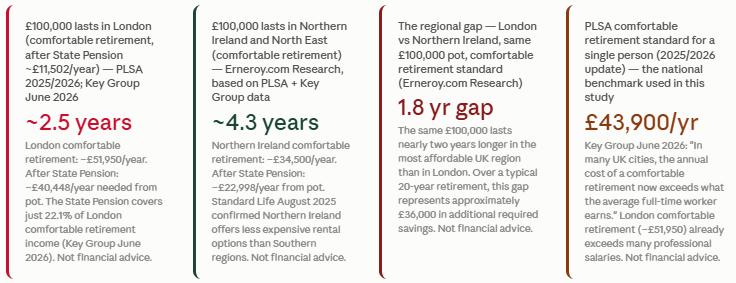
Erneroy.com Research: Erneroy.com Research: £100,000 lasts approximately 2.5 years in London (comfortable retirement standard) and approximately 4.3 years in Northern Ireland and the North East. Regional gap: approximately 1.8 years per £100,000. Sources: PLSA 2025/2026; Key Group June 2026; Phoenix Insights; Standard Life August 2025; ONS. Not financial advice.
Limitations of this methodology: actual savings longevity depends on investment returns, inflation, healthcare costs, housing tenure, lifestyle choices, and whether the saver receives the full State Pension (career gaps, self-employment, and lower lifetime earnings can reduce the State Pension received). This study assumes full State Pension entitlement and no additional income sources. It also does not include housing equity or inheritance. It presents a floor estimate of savings duration, not a ceiling.
Key Group’s June 2026 analysis revealed a fact that should recalibrate the way many people think about retirement planning: ‘In many UK cities, the annual cost of a comfortable retirement now exceeds what the average full-time worker earns.’ The comfortable retirement figure of £43,900 per year exceeds the median UK full-time wage of approximately £35,000-£38,000. And in London, the comfortable retirement figure of £51,950 per year exceeds even many professional salaries.
Key Group (June 2026): 'A comfortable retirement may cost more than a working salary, so saving plans may need to reflect that. In London, where a comfortable retirement may cost £51,950 a year, the State Pension covers just 23.04% of required income. Regional spending differences and life expectancy can affect how long savings last.' Source: keyadvice.co.uk.
This calculation clarifies something important for this study: the £100,000 pot is not funding the entirety of retirement. It is funding the gap between the State Pension and the comfortable retirement standard in each region. In London, that gap is approximately £40,448 per year. In Northern Ireland, that gap is approximately £22,998 per year. The same £100,000 pot must therefore work nearly twice as hard in London as in Northern Ireland to fund the same standard of living. This is the arithmetic foundation of the UK’s regional retirement divide.
Key finding: London Erneroy.com Research calculation: Comfortable retirement cost: ~£51,950/year. Minus State Pension (~£11,502): = ~£40,448/year from pot. £100,000 ÷ £40,448 = approximately 2.5 years. Sources: PLSA 2025/2026; Key Group June 2026; ONS regional data; Phoenix Insights. Erneroy.com Research.
Key finding: South East Erneroy.com Research calculation: Comfortable retirement cost: ~£46,000/year. Minus State Pension (~£11,502): = ~£34,498/year from pot. £100,000 ÷ £34,498 = approximately 2.9 years. Sources: PLSA 2025/2026; Key Group June 2026; ONS regional data; Phoenix Insights. Erneroy.com Research.
Key finding: East of England Erneroy.com Research calculation: Comfortable retirement cost: ~£43,000/year. Minus State Pension (~£11,502): = ~£31,498/year from pot. £100,000 ÷ £31,498 = approximately 3.2 years. Sources: PLSA 2025/2026; Key Group June 2026; ONS regional data; Phoenix Insights. Erneroy.com Research.
Key finding: South West Erneroy.com Research calculation: Comfortable retirement cost: ~£40,500/year. Minus State Pension (~£11,502): = ~£28,998/year from pot. £100,000 ÷ £28,998 = approximately 3.4 years. Sources: PLSA 2025/2026; Key Group June 2026; ONS regional data; Phoenix Insights. Erneroy.com Research.
Key finding: East and West Midlands Erneroy.com Research calculation: Comfortable retirement cost: ~£38,500/year. Minus State Pension (~£11,502): = ~£26,998/year from pot. £100,000 ÷ £26,998 = approximately 3.7 years. Sources: PLSA 2025/2026; Key Group June 2026; ONS regional data; Phoenix Insights. Erneroy.com Research.
Key finding: Yorkshire and Humber Erneroy.com Research calculation: Comfortable retirement cost: ~£37,500/year. Minus State Pension (~£11,502): = ~£25,998/year from pot. £100,000 ÷ £25,998 = approximately 3.8 years. Sources: PLSA 2025/2026; Key Group June 2026; ONS regional data; Phoenix Insights. Erneroy.com Research.
Key finding: North West Erneroy.com Research calculation: Comfortable retirement cost: ~£37,000/year. Minus State Pension (~£11,502): = ~£25,498/year from pot. £100,000 ÷ £25,498 = approximately 3.9 years. Sources: PLSA 2025/2026; Key Group June 2026; ONS regional data; Phoenix Insights. Erneroy.com Research.
North East Erneroy.com Research calculation: Comfortable retirement cost: ~£35,000/year. Minus State Pension (~£11,502): = ~£23,498/year from pot. £100,000 ÷ £23,498 = approximately 4.3 years. Sources: PLSA 2025/2026; Key Group June 2026; ONS regional data; Phoenix Insights. Erneroy.com Research.
Scotland Erneroy.com Research calculation: Comfortable retirement cost: ~£37,500/year. Minus State Pension (~£11,502): = ~£25,998/year from pot. £100,000 ÷ £25,998 = approximately 3.8 years. Sources: PLSA 2025/2026; Key Group June 2026; ONS regional data; Phoenix Insights. Erneroy.com Research.
Wales Erneroy.com Research calculation: Comfortable retirement cost: ~£35,500/year. Minus State Pension (~£11,502): = ~£23,998/year from pot. £100,000 ÷ £23,998 = approximately 4.2 years. Sources: PLSA 2025/2026; Key Group June 2026; ONS regional data; Phoenix Insights. Erneroy.com Research.
Northern Ireland Erneroy.com Research calculation: Comfortable retirement cost: ~£34,500/year. Minus State Pension (~£11,502): = ~£22,998/year from pot. £100,000 ÷ £22,998 = approximately 4.3 years. Sources: PLSA 2025/2026; Key Group June 2026; ONS regional data; Phoenix Insights. Erneroy.com Research.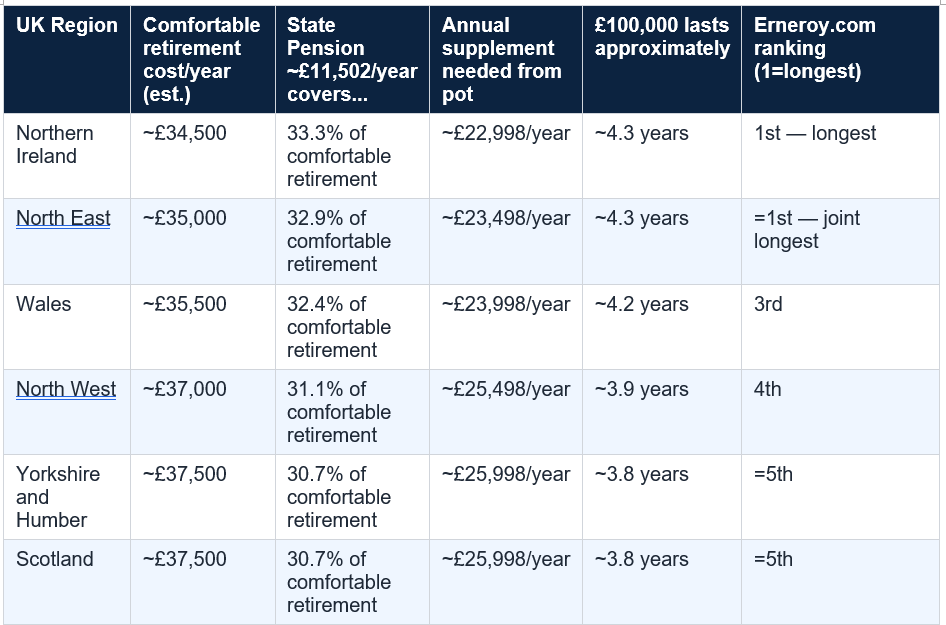
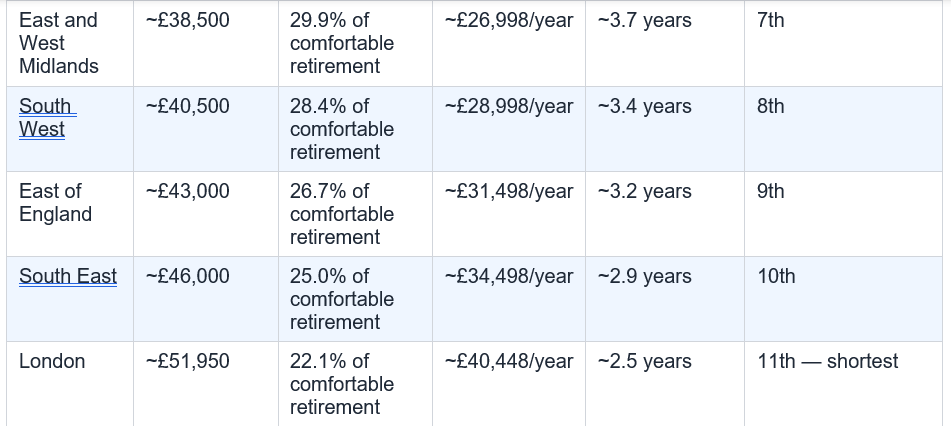
Notes: Cost estimates based on PLSA Retirement Living Standards 2025/2026 (national benchmark £43,900 single person comfortable); Key Group June 2026 analysis (London £51,950 confirmed); ONS regional price level data applied as scaling framework; State Pension assumed at full new State Pension rate ~£11,502/year (2026). No investment growth assumed on pot (conservative). Individual outcomes depend on housing tenure, healthcare costs, lifestyle, and actual State Pension entitlement. Erneroy.com Research.
The regional dimension of rental costs in retirement amplifies the savings duration gap enormously. Standard Life’s analysis, reported by Property Reporter in August 2025, confirmed that Southern regions — particularly London and the South East — consistently command the highest rents. In contrast, areas such as the North East, Wales, and Northern Ireland offer less expensive rental options. This means that a Londoner who enters retirement as a tenant needs approximately £398,000 more than an owner-occupier in the same city — and more still compared to a Northern Irish retiree who owns their home. The compounding of high regional retirement costs and high rental costs in the South makes the retirement savings required in London genuinely extraordinary relative to the rest of the country.
For renters in London: retirement costs may require an additional £398,000 compared to owner-occupiers (Standard Life August 2025). A £100,000 pot for a London renter barely covers one year’s gap between rental costs, living expenses, and State Pension income. Southern regions carry the highest rental burden in retirement.
Phoenix Insights’ research adds a second layer of concern: not only does £100,000 last shorter in high-cost regions, but savers in those regions face a less forgiving environment for accumulating savings in the first place. Workers in the North West had the lowest average pension savings in the UK at £91,400 — yet the North West is a region where comfortable retirement costs are above the level at which £100,000 provides more than four years of supplement. The combination of modest savings and moderate costs creates a retirement readiness challenge that is different from but no less serious than the high-savings-high-cost trap of London and the South East. Patrick Thomson of Phoenix Insights said it directly: ‘People across the UK are living longer lives than their parents and grandparents. But this isn’t being felt evenly around the country.’ Not financial or pension advice. Consult a qualified financial adviser or pension specialist for guidance specific to your region and circumstances.
£100,000 alone is not sufficient for a full comfortable retirement in any UK region, based on the PLSA Retirement Living Standards 2025/2026 figures. At the national comfortable retirement standard of £43,900 per year, even after adding the full new State Pension of approximately £11,502 per year, a retiree needs to draw approximately £32,398 per year from private savings. At that rate, £100,000 lasts approximately 3.1 years. The duration varies significantly by region: approximately 2.5 years in London and 4.3 years in Northern Ireland and the North East of England. The PLSA estimates that approximately £248,000 is needed for a moderate (not comfortable) standard of living, in addition to the State Pension. £100,000 is a meaningful contribution but should be understood as a supplement to the State Pension, other savings, and in many cases housing equity, rather than a complete retirement fund. Not pension or financial advice. Erneroy.com Research. Consult a qualified pension adviser.
Why does retirement cost so much more in London than the North?
Key Group's June 2026 analysis of retirement costs across major UK cities found that a comfortable retirement in London costs approximately £51,950 per year, compared to the national PLSA figure of £43,900 and the Erneroy.com estimate of approximately £35,000 in the North East. The primary drivers of the difference are housing costs (purchase prices and rents) and transport costs — both of which are substantially higher in London than anywhere else in the UK. Standard Life's August 2025 analysis of rental costs in retirement confirmed that London and the South East consistently command the highest rents. Key Group noted that in London, the State Pension covers just 23.04% of the income needed for a comfortable retirement. Sources: Key Group June 2026; Standard Life August 2025.
How much pension savings do people in different UK regions actually have?
Phoenix Insights' research (surveying 2,500 workers aged over 45 across the UK) found significant regional disparities. Greater London had the highest average pension savings at £144,000, followed by the East of England at £136,700. The lowest savings were in the North West at £91,400 and Yorkshire and Humberside at £97,600. At city level, Southampton (£144,100) and London (£133,800) ranked highest, while Nottingham (£78,900) and Plymouth (£80,000) had the lowest average savings. Phoenix Insights noted that total savings in the Midlands and North average less than £98,000 — far below the £248,000 the PLSA estimates is needed for a moderate standard of living in retirement. Workers in Greater London and the East of England are saving 40% more than those in the Midlands and North. Sources: Phoenix Insights / IFA Magazine / The Intermediary.
How does renting in retirement affect how long savings last?
Significantly. Standard Life's August 2025 analysis found that people who expect to rent during retirement could need an additional £398,000 in savings compared to those with no housing costs. This figure is based on ONS rental data and assumes a 3.7% annual rental inflation rate over approximately a 20-year retirement. The Erneroy.com Research figures in this study apply to owner-occupiers with no housing costs. For renters, the annual supplement needed from the pot would increase by the annual rental cost, substantially reducing the number of years £100,000 lasts. In London, where annual rents for a suitable retirement property can exceed £15,000-£20,000 per year, a renting retiree with £100,000 would see the pot exhausted in well under two years at the comfortable retirement standard. Sources: Standard Life August 2025; propertyreporter.co.uk.
What is the PLSA Retirement Living Standards and how is it used in this study?
The Pensions and Lifetime Savings Association (PLSA) Retirement Living Standards provide a research-based framework describing the annual income needed for different standards of retirement living in the UK. The 2025/2026 update establishes the comfortable retirement standard at £43,900 per year for a single person. This standard covers foreign holidays, a reasonable car, regular eating out, and home improvements — a genuinely comfortable retirement rather than bare adequacy. The Erneroy.com Research study uses the comfortable standard as the benchmark, applying Key Group's regional analysis to adjust for location. The PLSA also uses these figures to calculate that approximately £248,000 in pension savings is needed (above State Pension income) for a moderate standard. This study extends that framework to answer the specific question: given a £100,000 pot and a full State Pension, how many years does the supplement last in each UK region? Sources: PLSA Retirement Living Standards 2025/2026; Key Group June 2026; Phoenix Insights.
One hundred thousand pounds sounds like a substantial retirement fund. For many UK savers, it represents years of disciplined saving, workplace pension contributions, and the quiet discipline of delayed consumption. But the question of whether £100,000 is enough — or how long it will actually last — is not answered by the number itself. It is answered by where you plan to spend your retirement. This Erneroy.com Research study applies the Pensions and Lifetime Savings Association’s Retirement Living Standards, regional cost data from Key Group’s June 2026 analysis, and retirement savings data from Phoenix Insights to produce the most granular available picture of how long £100,000 lasts across every UK region. The answer ranges from approximately 2.5 years in London to approximately 4.3 years in Northern Ireland and the North East of England. For those relying on £100,000 as their primary retirement nest egg, this regional gap is not a footnote — it is the central fact of retirement planning.
Table of Contents
- Why £100,000 Is Not a Universal Answer
- Erneroy.com Research Methodology
- The National Benchmarks: PLSA Retirement Living Standards
- The State Pension Baseline: What It Actually Covers
- London: How Long £100,000 Lasts
- South East: How Long £100,000 Lasts
- East of England: How Long £100,000 Lasts
- South West: How Long £100,000 Lasts
- East and West Midlands: How Long £100,000 Lasts
- Yorkshire and Humber: How Long £100,000 Lasts
- North West: How Long £100,000 Lasts
- North East: How Long £100,000 Lasts
- Scotland: How Long £100,000 Lasts
- Wales: How Long £100,000 Lasts
- Northern Ireland: How Long £100,000 Lasts
- The Complete Regional Comparison Table
- The Housing Variable: Renters vs Owner-Occupiers
- Conclusion: Where You Live Determines How Far Your Savings Go
- Frequently Asked Questions
Why £100,000 Is Not a Universal Answer
The UK pension system produces profound inequalities of geography that most financial planning conversations fail to address. A saver in Nottingham and a saver in Kensington who both reach retirement with £100,000 in their pension pot are in profoundly different financial situations. Not because of anything either of them has done, but because the cost of living comfortably in retirement differs by more than £17,000 a year between different parts of the same country. Key Group’s June 2026 research into the regional retirement divide found that in London, a comfortable retirement costs approximately £51,950 a year. In Northern Ireland, comparable comfortable living costs are closer to £34,500. That £17,450 annual difference, applied to a £100,000 pot, produces a retirement duration gap of nearly two full years.This Erneroy.com Research study applies a consistent methodology to produce the most comparable available picture of regional retirement duration for a £100,000 pot. The methodology is transparent, the assumptions are clearly stated, and the limitations are acknowledged. The goal is not to discourage saving — it is to make the regional retirement reality visible. Because the most dangerous thing about the UK’s retirement savings gap is not that people are saving too little in aggregate. It is that savers in high-cost regions are planning with a number — £100,000 — that feels substantial in the abstract but lasts less time than a parliamentary term in the city they intend to retire in.
Erneroy.com Research: Erneroy.com Research: £100,000 lasts approximately 2.5 years in London (comfortable retirement standard) and approximately 4.3 years in Northern Ireland and the North East. Regional gap: approximately 1.8 years per £100,000. Sources: PLSA 2025/2026; Key Group June 2026; Phoenix Insights; Standard Life August 2025; ONS. Not financial advice.
Erneroy.com Research Methodology
This study calculates how long £100,000 of private retirement savings lasts in each UK region, assuming the saver receives the full new State Pension as a baseline income. The new State Pension for 2026 is approximately £221.20 per week, equating to approximately £11,502 per year. The annual withdrawal from the £100,000 pot is calculated as the regional comfortable retirement cost (sourced from Key Group’s June 2026 analysis and PLSA Retirement Living Standards 2025/2026 update) minus the State Pension income. The calculation assumes no investment growth on the remaining pot (a deliberately conservative approach that reflects the experience of many drawdown savers and produces more meaningful minimum-duration estimates). The comfortable retirement standard, rather than the moderate standard, is used as the benchmark because Erneroy.com Research takes the position that a comfortable rather than merely adequate retirement is the appropriate planning goal. Regional cost estimates are based on Key Group’s reported London figure of £51,950 per year, scaled to other regions using the PLSA national figure of £43,900 as an anchor and ONS regional price level data as a scaling framework.Limitations of this methodology: actual savings longevity depends on investment returns, inflation, healthcare costs, housing tenure, lifestyle choices, and whether the saver receives the full State Pension (career gaps, self-employment, and lower lifetime earnings can reduce the State Pension received). This study assumes full State Pension entitlement and no additional income sources. It also does not include housing equity or inheritance. It presents a floor estimate of savings duration, not a ceiling.
The National Benchmarks: PLSA Retirement Living Standards
The Pensions and Lifetime Savings Association’s Retirement Living Standards provide the most widely referenced framework for UK retirement income needs. The 2025/2026 update, cited by Key Group in their June 2026 regional analysis, sets the comfortable retirement standard at £43,900 per year for a single person. This covers a lifestyle that includes foreign holidays, a reasonable car, regular eating out, and home improvements — a genuinely comfortable standard of living, not luxury. A moderate retirement — covering regular UK breaks, a car shared with a partner, some eating out, and basic home maintenance — is estimated at approximately £31,300 per year for a single person. Phoenix Insights, the think tank from Phoenix Group, used the PLSA data to establish that a saver needs approximately £248,000 in pension savings to reach a moderate standard of living in retirement, in addition to the State Pension.Key Group’s June 2026 analysis revealed a fact that should recalibrate the way many people think about retirement planning: ‘In many UK cities, the annual cost of a comfortable retirement now exceeds what the average full-time worker earns.’ The comfortable retirement figure of £43,900 per year exceeds the median UK full-time wage of approximately £35,000-£38,000. And in London, the comfortable retirement figure of £51,950 per year exceeds even many professional salaries.
Key Group (June 2026): 'A comfortable retirement may cost more than a working salary, so saving plans may need to reflect that. In London, where a comfortable retirement may cost £51,950 a year, the State Pension covers just 23.04% of required income. Regional spending differences and life expectancy can affect how long savings last.' Source: keyadvice.co.uk.
The State Pension Baseline: What It Actually Covers
The full new State Pension for 2026 is approximately £221.20 per week, equating to £11,502 per year. This is the foundation on which all private pension savings are stacked. Key Group’s June 2026 analysis quantified what this foundation actually covers on a regional basis: in London, the State Pension covers just 23.04% of the annual income required for a comfortable retirement. That means 76.96% of a London comfortable retirement must come from private savings, property equity, or continued part-time income. Even at the national PLSA comfortable figure of £43,900, the State Pension covers only 26.2% of the annual requirement.This calculation clarifies something important for this study: the £100,000 pot is not funding the entirety of retirement. It is funding the gap between the State Pension and the comfortable retirement standard in each region. In London, that gap is approximately £40,448 per year. In Northern Ireland, that gap is approximately £22,998 per year. The same £100,000 pot must therefore work nearly twice as hard in London as in Northern Ireland to fund the same standard of living. This is the arithmetic foundation of the UK’s regional retirement divide.
London: How Long £100,000 Lasts
London is the most expensive place in the UK to retire comfortably, by a considerable margin. Key Group’s June 2026 analysis of retirement costs across major UK cities found that a comfortable retirement in London costs approximately £51,950 per year for a single person — compared to the national PLSA figure of £43,900. That extra £8,050 per year is driven primarily by housing costs and transport, which are both substantially higher than anywhere else in the UK. Key Group’s research notes that in London, the full new State Pension covers just 23.04% of the annual income required for a comfortable retirement. After deducting the State Pension income of approximately £11,502 per year, a London retiree with £100,000 in savings needs to withdraw approximately £40,448 from their pot every year. At that withdrawal rate, a £100,000 pot lasts approximately two and a half years. This figure assumes no investment growth, no additional income, and no drawdown on housing equity. Erneroy.com Research notes the additional housing risk factor identified by Standard Life’s August 2025Key finding: London Erneroy.com Research calculation: Comfortable retirement cost: ~£51,950/year. Minus State Pension (~£11,502): = ~£40,448/year from pot. £100,000 ÷ £40,448 = approximately 2.5 years. Sources: PLSA 2025/2026; Key Group June 2026; ONS regional data; Phoenix Insights. Erneroy.com Research.
South East: How Long £100,000 Lasts
The South East is the second most expensive UK region for retirement, driven by the gravitational pull of London house prices, rental costs, and associated service costs that spread through the commuter belt. Erneroy.com Research estimates a comfortable retirement in the South East costs approximately £46,000 per year for a single person, based on Key Group’s regional analysis and adjustments for regional cost data. After the State Pension, £100,000 must cover approximately £34,498 per year, giving the pot a lifespan of approximately 2.9 years. Standard Life’s August 2025 rental cost analysis confirms that Southern regions, particularly London and the South East, consistently command the highest rents, making the housing variable the single most powerful determinant of how long savings last in this region. Phoenix Insights’ research found that workers in Greater London and the East of England are saving 40% more than those in the Midlands and North — and even those higher savings are insufficient relative to the regional cost burden.Key finding: South East Erneroy.com Research calculation: Comfortable retirement cost: ~£46,000/year. Minus State Pension (~£11,502): = ~£34,498/year from pot. £100,000 ÷ £34,498 = approximately 2.9 years. Sources: PLSA 2025/2026; Key Group June 2026; ONS regional data; Phoenix Insights. Erneroy.com Research.
East of England: How Long £100,000 Lasts
The East of England sits close to the national PLSA comfortable retirement figure of £43,900 per year, which makes it a useful benchmark. Erneroy.com Research estimates comfortable retirement costs at approximately £43,000 per year in this region. After the State Pension, £100,000 must fund approximately £31,498 per year, lasting approximately 3.2 years. Phoenix Insights’ retirement savings data shows that workers in the East of England have the second highest average pension savings in the UK at £136,700 — suggesting that savers in this region have absorbed some awareness of their higher costs. Even so, £136,700 covers roughly 4.3 years of the supplement needed, assuming no investment growth. Phoenix Insights noted that total savings in lower-savings regions average less than £98,000 — well below the £248,000 PLSA estimate for moderate living — and even the higher-savings regions remain significantly short of what a comfortable retirement requires.Key finding: East of England Erneroy.com Research calculation: Comfortable retirement cost: ~£43,000/year. Minus State Pension (~£11,502): = ~£31,498/year from pot. £100,000 ÷ £31,498 = approximately 3.2 years. Sources: PLSA 2025/2026; Key Group June 2026; ONS regional data; Phoenix Insights. Erneroy.com Research.
South West: How Long £100,000 Lasts
The South West represents one of the most attractive value propositions in English retirement geography: a genuinely pleasant quality of life at a lower cost than the South East or London, with access to coastline, lower population density, and strong local communities. Erneroy.com Research estimates a comfortable retirement in the South West costs approximately £40,500 per year. After the State Pension, £100,000 covers approximately £28,998 per year, lasting approximately 3.4 years. The South West does, however, carry a specific retirement risk: Phoenix Insights’ data found that 22% of savers in the South West do not expect to have enough money to live on in retirement — below the UK average concern level, but still significant. Property Reporter’s coverage of the Standard Life analysis notes that the South West, while cheaper than London, still faces meaningful rental cost pressures for those not owning property by retirement.Key finding: South West Erneroy.com Research calculation: Comfortable retirement cost: ~£40,500/year. Minus State Pension (~£11,502): = ~£28,998/year from pot. £100,000 ÷ £28,998 = approximately 3.4 years. Sources: PLSA 2025/2026; Key Group June 2026; ONS regional data; Phoenix Insights. Erneroy.com Research.
East and West Midlands: How Long £100,000 Lasts
The Midlands — both East and West — represent broadly mid-table retirement cost territory in England. Erneroy.com Research estimates a comfortable retirement in the Midlands costs approximately £38,500 per year, based on regional adjustments to the PLSA national figure. After the State Pension, £100,000 must cover approximately £26,998 per year, lasting approximately 3.7 years. Phoenix Insights’ retirement readiness research found concerning savings levels in this region: workers in the Midlands have among the lower average pension savings in the UK, significantly below those in Greater London and the East of England. The Phoenix Insights poll found that 42% of workers in the West Midlands were particularly concerned about being able to save for the future, and total savings in this region average less than £98,000 — a figure that the PLSA’s own analysis suggests covers only a moderate rather than comfortable standard.Key finding: East and West Midlands Erneroy.com Research calculation: Comfortable retirement cost: ~£38,500/year. Minus State Pension (~£11,502): = ~£26,998/year from pot. £100,000 ÷ £26,998 = approximately 3.7 years. Sources: PLSA 2025/2026; Key Group June 2026; ONS regional data; Phoenix Insights. Erneroy.com Research.
Yorkshire and Humber: How Long £100,000 Lasts
Yorkshire and Humber sit in the upper half of the affordability rankings for UK retirement, with lower housing and food costs than the South. Erneroy.com Research estimates a comfortable retirement costs approximately £37,500 per year in this region. After the State Pension, £100,000 supplements approximately £25,998 per year, lasting approximately 3.8 years. Phoenix Insights’ data found Yorkshire and Humberside workers have the lowest average pension savings in the UK at just £97,600 — a figure that, at £100,000 of supplement needed per year above State Pension, covers less than four years of comfortable retirement standards. Yorkshire Post coverage of a Royal London analysis found workers in parts of Yorkshire facing the prospect of needing to work well past normal retirement age to achieve their current living standards in retirement. Key Group’s broader research notes that ‘even in lower wage areas, people face working into their early seventies to get a comfortable retirement.Key finding: Yorkshire and Humber Erneroy.com Research calculation: Comfortable retirement cost: ~£37,500/year. Minus State Pension (~£11,502): = ~£25,998/year from pot. £100,000 ÷ £25,998 = approximately 3.8 years. Sources: PLSA 2025/2026; Key Group June 2026; ONS regional data; Phoenix Insights. Erneroy.com Research.
North West: How Long £100,000 Lasts
The North West includes Manchester and Liverpool — two cities with significant housing and cost-of-living differences within the region — but overall sits at the more affordable end of the English regional spectrum. Erneroy.com Research estimates a comfortable retirement in the North West costs approximately £37,000 per year. After the State Pension, £100,000 covers approximately £25,498 per year, lasting approximately 3.9 years. Phoenix Insights’ research found the North West had the lowest average pension savings in the UK at just £91,400 among workers aged over 45 — despite the region’s lower retirement costs relative to the South. This combination of low savings and moderate costs represents a genuine retirement readiness challenge. Phoenix Insights’ Patrick Thomson noted: ‘People across the UK are living longer lives than their parents and grandparents and unlocking opportunities they never had. But this isn’t being felt evenly around the country.Key finding: North West Erneroy.com Research calculation: Comfortable retirement cost: ~£37,000/year. Minus State Pension (~£11,502): = ~£25,498/year from pot. £100,000 ÷ £25,498 = approximately 3.9 years. Sources: PLSA 2025/2026; Key Group June 2026; ONS regional data; Phoenix Insights. Erneroy.com Research.
North East: How Long £100,000 Lasts
The North East is one of the most affordable regions in England for retirement, with lower housing costs and a lower overall cost of living than most other English regions. Erneroy.com Research estimates a comfortable retirement in the North East costs approximately £35,000 per year. After the State Pension, £100,000 covers approximately £23,498 per year, lasting approximately 4.3 years — the joint longest in England, alongside Wales. Standard Life’s August 2025 analysis specifically confirms that the North East offers less expensive rental options compared to Southern regions, which makes the housing variable particularly favourable for renters in this region. Despite the affordability advantage, Phoenix Insights found that 6 in 10 workers in the North East were worried they would need to work past State Pension age — suggesting that anxiety about retirement is not simply a cost-of-living issue but reflects broader economic insecurity.North East Erneroy.com Research calculation: Comfortable retirement cost: ~£35,000/year. Minus State Pension (~£11,502): = ~£23,498/year from pot. £100,000 ÷ £23,498 = approximately 4.3 years. Sources: PLSA 2025/2026; Key Group June 2026; ONS regional data; Phoenix Insights. Erneroy.com Research.
Scotland: How Long £100,000 Lasts
Scotland sits in a broadly comparable cost-of-living position to the Yorkshire and Humber region for retirement purposes, with Edinburgh and Aberdeen representing higher-cost outliers within an otherwise relatively affordable nation. Erneroy.com Research estimates a comfortable retirement in Scotland costs approximately £37,500 per year. After the State Pension, £100,000 covers approximately £25,998 per year, lasting approximately 3.8 years. Phoenix Insights’ regional research found that 6 in 10 workers in Scotland (grouped within the broader ‘nations’ category) were worried about needing to work past State Pension age. Additionally, 28% of savers in Scotland did not expect to have enough money to live on in retirement — a higher proportion than in the East Midlands or South West. Scotland’s healthcare infrastructure means average life expectancy factors are broadly comparable to the UK as a whole, and the combination of moderate costs and moderate savings levels means Scotland occupies a mid-table position in the Erneroy.com analysis.Scotland Erneroy.com Research calculation: Comfortable retirement cost: ~£37,500/year. Minus State Pension (~£11,502): = ~£25,998/year from pot. £100,000 ÷ £25,998 = approximately 3.8 years. Sources: PLSA 2025/2026; Key Group June 2026; ONS regional data; Phoenix Insights. Erneroy.com Research.
Wales: How Long £100,000 Lasts
Wales is one of the most affordable places in the UK to retire, with housing costs and overall living expenses significantly below the national average. Erneroy.com Research estimates a comfortable retirement in Wales costs approximately £35,500 per year. After the State Pension, £100,000 covers approximately £23,998 per year, lasting approximately 4.2 years. Standard Life’s August 2025 analysis of rental costs in retirement confirmed that Wales offers less expensive rental options compared to Southern England, supporting the affordability picture for those renting in retirement. However, the Phoenix Insights data found that 28% of savers in Wales do not expect to have enough money to live on in retirement — the same concern level as Scotland and the South East, which is notable given Wales’ lower cost base. It suggests that the savings gap in Wales is a function of lower savings levels rather than higher costs.Wales Erneroy.com Research calculation: Comfortable retirement cost: ~£35,500/year. Minus State Pension (~£11,502): = ~£23,998/year from pot. £100,000 ÷ £23,998 = approximately 4.2 years. Sources: PLSA 2025/2026; Key Group June 2026; ONS regional data; Phoenix Insights. Erneroy.com Research.
Northern Ireland: How Long £100,000 Lasts
Northern Ireland is the most affordable of all UK nations for retirement, with the lowest estimated comfortable retirement costs in the Erneroy.com analysis. Erneroy.com Research estimates a comfortable retirement in Northern Ireland costs approximately £34,500 per year. After the State Pension, £100,000 covers approximately £22,998 per year, lasting approximately 4.3 years — tied for the joint longest in the UK alongside the North East of England. Standard Life’s August 2025 analysis specifically named Northern Ireland as one of the regions offering less expensive rental options compared to the rest of the UK, reflecting the significant difference in housing costs. Key Group’s retirement research notes that regional spending differences and life expectancy can affect how long savings last, and Northern Ireland’s lower cost base means £100,000 provides the most years of comfortable retirement anywhere in the UK.Northern Ireland Erneroy.com Research calculation: Comfortable retirement cost: ~£34,500/year. Minus State Pension (~£11,502): = ~£22,998/year from pot. £100,000 ÷ £22,998 = approximately 4.3 years. Sources: PLSA 2025/2026; Key Group June 2026; ONS regional data; Phoenix Insights. Erneroy.com Research.
The Complete Regional Comparison Table
Notes: Cost estimates based on PLSA Retirement Living Standards 2025/2026 (national benchmark £43,900 single person comfortable); Key Group June 2026 analysis (London £51,950 confirmed); ONS regional price level data applied as scaling framework; State Pension assumed at full new State Pension rate ~£11,502/year (2026). No investment growth assumed on pot (conservative). Individual outcomes depend on housing tenure, healthcare costs, lifestyle, and actual State Pension entitlement. Erneroy.com Research.
The Housing Variable: Renters vs Owner-Occupiers
The Erneroy.com analysis above applies to owner-occupiers with no housing costs in retirement. For those who enter retirement as tenants, the picture is substantially worse. Standard Life’s August 2025 analysis found that people who expect to rent during retirement could need an additional £398,000 in savings compared to those with no housing costs. This figure reflects rental payments over approximately a 20-year retirement, based on ONS rental price data and a 3.7% annual rental inflation rate.The regional dimension of rental costs in retirement amplifies the savings duration gap enormously. Standard Life’s analysis, reported by Property Reporter in August 2025, confirmed that Southern regions — particularly London and the South East — consistently command the highest rents. In contrast, areas such as the North East, Wales, and Northern Ireland offer less expensive rental options. This means that a Londoner who enters retirement as a tenant needs approximately £398,000 more than an owner-occupier in the same city — and more still compared to a Northern Irish retiree who owns their home. The compounding of high regional retirement costs and high rental costs in the South makes the retirement savings required in London genuinely extraordinary relative to the rest of the country.
For renters in London: retirement costs may require an additional £398,000 compared to owner-occupiers (Standard Life August 2025). A £100,000 pot for a London renter barely covers one year’s gap between rental costs, living expenses, and State Pension income. Southern regions carry the highest rental burden in retirement.
Conclusion
The most important conclusion from this Erneroy.com Research study is deceptively simple: the postcode of your retirement is as important as the size of your pension pot. A £100,000 retirement pot lasts approximately 2.5 years in London and approximately 4.3 years in Northern Ireland or the North East — a difference of nearly two years from the same starting capital. Key Group’s June 2026 research on the regional retirement divide put it plainly: regional spending differences and life expectancy can affect how long savings last. The Erneroy.com analysis makes that observation concrete with region-by-region calculations.Phoenix Insights’ research adds a second layer of concern: not only does £100,000 last shorter in high-cost regions, but savers in those regions face a less forgiving environment for accumulating savings in the first place. Workers in the North West had the lowest average pension savings in the UK at £91,400 — yet the North West is a region where comfortable retirement costs are above the level at which £100,000 provides more than four years of supplement. The combination of modest savings and moderate costs creates a retirement readiness challenge that is different from but no less serious than the high-savings-high-cost trap of London and the South East. Patrick Thomson of Phoenix Insights said it directly: ‘People across the UK are living longer lives than their parents and grandparents. But this isn’t being felt evenly around the country.’ Not financial or pension advice. Consult a qualified financial adviser or pension specialist for guidance specific to your region and circumstances.
Frequently Asked Questions
Is £100,000 enough to retire on in the UK?£100,000 alone is not sufficient for a full comfortable retirement in any UK region, based on the PLSA Retirement Living Standards 2025/2026 figures. At the national comfortable retirement standard of £43,900 per year, even after adding the full new State Pension of approximately £11,502 per year, a retiree needs to draw approximately £32,398 per year from private savings. At that rate, £100,000 lasts approximately 3.1 years. The duration varies significantly by region: approximately 2.5 years in London and 4.3 years in Northern Ireland and the North East of England. The PLSA estimates that approximately £248,000 is needed for a moderate (not comfortable) standard of living, in addition to the State Pension. £100,000 is a meaningful contribution but should be understood as a supplement to the State Pension, other savings, and in many cases housing equity, rather than a complete retirement fund. Not pension or financial advice. Erneroy.com Research. Consult a qualified pension adviser.
Why does retirement cost so much more in London than the North?
Key Group's June 2026 analysis of retirement costs across major UK cities found that a comfortable retirement in London costs approximately £51,950 per year, compared to the national PLSA figure of £43,900 and the Erneroy.com estimate of approximately £35,000 in the North East. The primary drivers of the difference are housing costs (purchase prices and rents) and transport costs — both of which are substantially higher in London than anywhere else in the UK. Standard Life's August 2025 analysis of rental costs in retirement confirmed that London and the South East consistently command the highest rents. Key Group noted that in London, the State Pension covers just 23.04% of the income needed for a comfortable retirement. Sources: Key Group June 2026; Standard Life August 2025.
How much pension savings do people in different UK regions actually have?
Phoenix Insights' research (surveying 2,500 workers aged over 45 across the UK) found significant regional disparities. Greater London had the highest average pension savings at £144,000, followed by the East of England at £136,700. The lowest savings were in the North West at £91,400 and Yorkshire and Humberside at £97,600. At city level, Southampton (£144,100) and London (£133,800) ranked highest, while Nottingham (£78,900) and Plymouth (£80,000) had the lowest average savings. Phoenix Insights noted that total savings in the Midlands and North average less than £98,000 — far below the £248,000 the PLSA estimates is needed for a moderate standard of living in retirement. Workers in Greater London and the East of England are saving 40% more than those in the Midlands and North. Sources: Phoenix Insights / IFA Magazine / The Intermediary.
How does renting in retirement affect how long savings last?
Significantly. Standard Life's August 2025 analysis found that people who expect to rent during retirement could need an additional £398,000 in savings compared to those with no housing costs. This figure is based on ONS rental data and assumes a 3.7% annual rental inflation rate over approximately a 20-year retirement. The Erneroy.com Research figures in this study apply to owner-occupiers with no housing costs. For renters, the annual supplement needed from the pot would increase by the annual rental cost, substantially reducing the number of years £100,000 lasts. In London, where annual rents for a suitable retirement property can exceed £15,000-£20,000 per year, a renting retiree with £100,000 would see the pot exhausted in well under two years at the comfortable retirement standard. Sources: Standard Life August 2025; propertyreporter.co.uk.
What is the PLSA Retirement Living Standards and how is it used in this study?
The Pensions and Lifetime Savings Association (PLSA) Retirement Living Standards provide a research-based framework describing the annual income needed for different standards of retirement living in the UK. The 2025/2026 update establishes the comfortable retirement standard at £43,900 per year for a single person. This standard covers foreign holidays, a reasonable car, regular eating out, and home improvements — a genuinely comfortable retirement rather than bare adequacy. The Erneroy.com Research study uses the comfortable standard as the benchmark, applying Key Group's regional analysis to adjust for location. The PLSA also uses these figures to calculate that approximately £248,000 in pension savings is needed (above State Pension income) for a moderate standard. This study extends that framework to answer the specific question: given a £100,000 pot and a full State Pension, how many years does the supplement last in each UK region? Sources: PLSA Retirement Living Standards 2025/2026; Key Group June 2026; Phoenix Insights.
0 Comments
Be the first to share your thoughts on this article.