
Investing
If Stocks Tumble, Buffett Says This Is the Best Move to Make

Market downturns have historically been ideal times for patient investors to buy stocks. Here is the evidence, and the catches. Median S&P 500 return one year after closing in a bear market: 23.9%; average bear market lasts about 12 months with a 33% fall; Berkshire cash $397.4B at end of Q1 2026.
History gives that advice support, but with catches. After the S&P 500 closed in a bear market, the median return a year later was 23.9% since 1950. Bear markets also last, on average, about a year and can fall a third or more. And, interestingly, Berkshire Hathaway itself sat on a record cash pile through a 9% dip earlier this year rather than rushing in.
So the real lesson is not "buy every dip". It is to prepare before the fall, buy quality businesses at lower prices, and keep going even when it is uncomfortable. I explain each part below.
Key takeaway: Buffett's rule is about price and temperament. The best move is to have cash and a plan ready, so that when fear is everywhere you can buy steadily instead of freezing or selling.
He has also said that "bad news is an investor's best friend" because it lets you buy a slice of America's future at a marked-down price. And in an interview with CNBC this year, as quoted by the Motley Fool, he said the most likely time to buy things is when nobody else will answer their phones. Note two things. First, I am relying on secondary articles for these quotes, so the exact wording and dates may differ slightly between sources. Second, the words describe an attitude, not a timetable. Buffett never said "buy on the first red day".
The Gretzky comparison is useful. Buffett's advice was to think like the hockey player who skates to where the puck is going to be, not where it has been. Markets tend to move ahead of sentiment and economic recovery, so by the time the news feels better, prices have often already recovered.
A plain example makes it concrete. Imagine you want to own a company whose shares cost $100. After a crash they cost $60, and the business is still earning money. If you believe in its long-term prospects, you now get 66% more shares for the same money (my calculation: $100 buys 1.67 shares at $60 instead of 1.0 at $100). That is the idea behind the rule, though in real life it is never so clean. The key phrase is "if you believe in the business". Buffett looked for companies with strong returns on invested capital and fortress balance sheets that could cope with a tough market. A cheap price on a weak company is not a bargain.
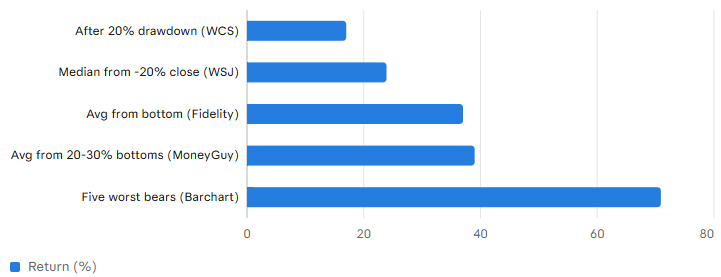
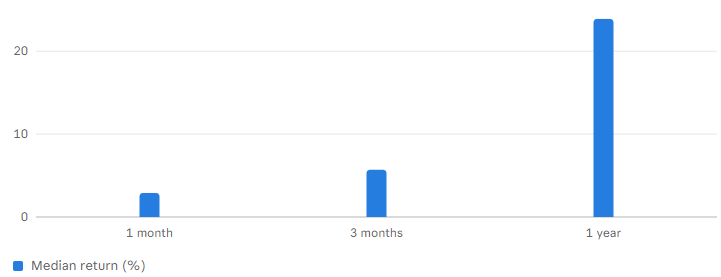
Counting from the actual bottom gives bigger numbers. Fidelity's analysis of 1950 to 2022 found an average return of 37% in the year after a bear market bottom [18]. MoneyGuy found that for bear markets that bottomed out between 20% and 30%, the average return in the following 12 months was 39%. And Barchart, citing the five worst bear markets since 1929, says the market averaged 70.9% in the first year after the bottom.
The catch is that nobody knows the bottom in real time. Barchart says it is impossible to know when a bottom has arrived. So the more realistic figures are those that start at the point you could actually act. An analysis by A Wealth of Common Sense, covering 1950 to 2026, found average one-year gains of 15%, 17% and 21% after 10%, 20% and 30% drawdowns, with five-year gains of 72% to 88% and win rates above 70%. LPL Financial's Ryan Detrick noted that in only three instances were stocks lower a year after a bear market.
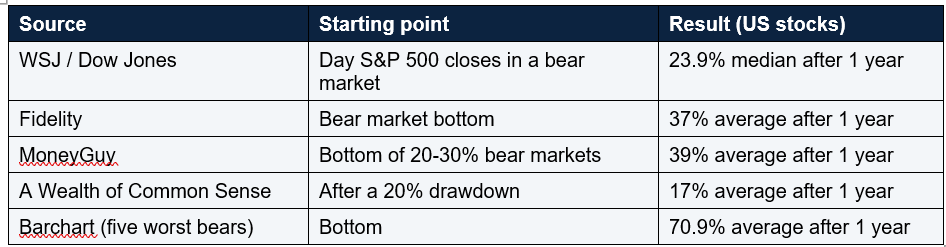
To turn that into money, a 23.9% gain on $10,000 is $12,390, and 17% is $11,700 (my calculation). The numbers vary a lot, which is itself the message: expect a range, not a promise.
Recovery takes time too. One source says it takes stocks 19 months on average to recover fully from bear market losses . AAII's Sam Stovall found that the typical "garden-variety" bear market, with declines of 20% to 39.9%, took only 14 months to recover, but also that only about six months on average separate the end of one 5%-plus decline and the start of the next.
Put simply, if you buy during a fall, you should expect to be down on that purchase for a while. The maths of losses explains why. A 20% fall needs a 25% gain to get back, and a 50% fall needs a 100% gain (my calculation). That asymmetry is why timing and sizing matter. Frequency also matters. AAII counts 56 pullbacks, 21 corrections and 12 bear markets since World War II, with a new bear market on average every 4.8 years. Drops are normal, which is the basis for planning ahead.
TheStreet notes that when the S&P 500 dropped roughly 9% from its January highs, many assumed the dip would lure Buffett into the market, but Berkshire's cash climbed instead. The Motley Fool argues the cash is less a market call than a sign that Berkshire struggles to find much worth buying at today's prices. That is a useful reminder. Buffett's rule is about being greedy when others are fearful, and a 9% dip is not fear. Another writer makes the same point: his words do not mean he piles into every downturn, only that he expects more opportunities at the right price.
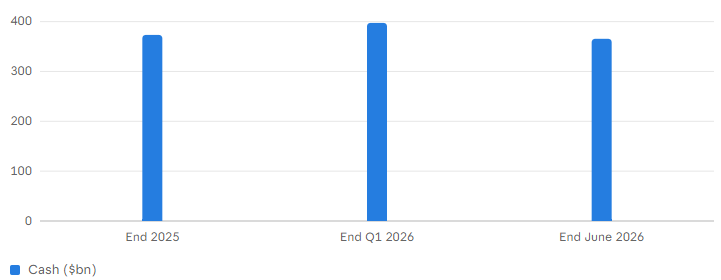
The cash has begun moving under new CEO Greg Abel. CNBC reported that Berkshire's cash fell to $365.5 billion at the end of June as it deployed capital on buybacks and other investments. By my calculation that is a $31.9 billion drop from the first quarter. Another article says Abel deployed $32 billion in one quarter. A word of caution on dates: a 24/7 Wall St article labels the $365.5 billion figure as "end of Q3 2026" , while CNBC places it at the end of June. I would trust the CNBC date, which matches the quarterly report, but check Berkshire's own filings if it matters.
The Motley Fool puts it well: investors who prepare for the moment will be better positioned to pull the trigger. For a household, that might mean holding a few months of spending in cash, and keeping a separate pot for investing each month.
If you hold individual shares, ask three questions: does the company make money, can it survive a long downturn, and do I understand how it earns? If the answer to any is no, a lower price may not help.
The bear case: a crash can run for a year or more, losses can deepen after you buy, recovery is not guaranteed, and even Berkshire waited through a 9% dip with record cash.
Both are true. The practical answer is to buy gradually, hold quality, and keep reserves for living costs.
So prepare before the fall, buy in steps, and judge businesses, not headlines. Even Berkshire, with nearly $400 billion, waited for the right price. This post is education only, not advice.
His best-known line is to be fearful when others are greedy and greedy when others are fearful. In practice, that means buying quality at lower prices.
Does buying after a crash really work?
Historically, often yes: the median one-year return after the S&P 500 closed in a bear market was 23.9% since 1950. It is not guaranteed.
How long do bear markets last?
Capital Group says the average since 1950 was 12 months with a 33% decline. Another source says recovery takes about 19 months on average.
Why does Berkshire hold so much cash?
A record $397.4 billion at the end of Q1 2026. One analysis says it reflects difficulty finding bargains at current prices.
Should I wait for the bottom before buying?
Nobody can know the bottom in real time. Many investors buy in steps instead. Consider speaking to a regulated adviser about your own situation.
Table of Contents
- The quick answer
- What Buffett actually said
- Why buying when others are fearful makes sense
- What history says after big drops
- Why it still feels awful
- Berkshire's own cash pile tells a more careful story
- Reason 1: Have money ready before the crash
- Reason 2: Buy quality, not just cheap
- Reason 3: Spread your buying and keep going
- The mistakes that cost people most
- Counterpoints and honest limits
- A simple crash plan
- Conclusion
- FAQ
One-year S&P 500 return after a bear market, by study
% return after 1 year by Studies start from different points, so they differ
Berkshire Hathaway cash pile ($ billions)
US dollars, billions by Sources: TheStreet, CNBC
S&P 500 median return after closing in a bear market
% return by Source: WSJ / Dow Jones Market Data, since 1950
The quick answer
Warren Buffett's best-known advice for a market crash is short: be fearful when others are greedy, and be greedy when others are fearful. In plain words, a crash is when good businesses go on sale, so the best move for a patient investor is usually to keep buying, not to run.History gives that advice support, but with catches. After the S&P 500 closed in a bear market, the median return a year later was 23.9% since 1950. Bear markets also last, on average, about a year and can fall a third or more. And, interestingly, Berkshire Hathaway itself sat on a record cash pile through a 9% dip earlier this year rather than rushing in.
So the real lesson is not "buy every dip". It is to prepare before the fall, buy quality businesses at lower prices, and keep going even when it is uncomfortable. I explain each part below.
Key takeaway: Buffett's rule is about price and temperament. The best move is to have cash and a plan ready, so that when fear is everywhere you can buy steadily instead of freezing or selling.
What Buffett actually said
The famous line is usually traced to his 1986 letter to shareholders, where he wrote that Berkshire tries to be fearful when others are greedy and greedy only when others are fearful. Another article puts a similar line in the 1980s letters. In 2008, during the financial crisis, he wrote a New York Times opinion piece titled "Buy American. I am." In it, he said a simple rule dictates his buying, and that fear was widespread, even among seasoned investors.He has also said that "bad news is an investor's best friend" because it lets you buy a slice of America's future at a marked-down price. And in an interview with CNBC this year, as quoted by the Motley Fool, he said the most likely time to buy things is when nobody else will answer their phones. Note two things. First, I am relying on secondary articles for these quotes, so the exact wording and dates may differ slightly between sources. Second, the words describe an attitude, not a timetable. Buffett never said "buy on the first red day".
Why buying when others are fearful makes sense
The logic is about price versus value. When the market falls, the same companies cost less. One writer explains that as stocks fall, so do valuations, and beaten-down names can offer wonderful opportunities. Another says economic downturns bring prices down, giving long-term investors the chance to buy great companies at a discount.The Gretzky comparison is useful. Buffett's advice was to think like the hockey player who skates to where the puck is going to be, not where it has been. Markets tend to move ahead of sentiment and economic recovery, so by the time the news feels better, prices have often already recovered.
A plain example makes it concrete. Imagine you want to own a company whose shares cost $100. After a crash they cost $60, and the business is still earning money. If you believe in its long-term prospects, you now get 66% more shares for the same money (my calculation: $100 buys 1.67 shares at $60 instead of 1.0 at $100). That is the idea behind the rule, though in real life it is never so clean. The key phrase is "if you believe in the business". Buffett looked for companies with strong returns on invested capital and fortress balance sheets that could cope with a tough market. A cheap price on a weak company is not a bargain.
What history says after big drops
Here is what the numbers say about the period after big drops. Different studies measure from different starting points, so they do not match, and I will flag that. The Wall Street Journal, using Dow Jones Market Data, found that since 1950 the S&P 500's median return one month after closing in a bear market was 2.9%, three months after was 5.7%, and a year after was 23.9%. That counts from the day the index first closed 20% down, not from the bottom.Counting from the actual bottom gives bigger numbers. Fidelity's analysis of 1950 to 2022 found an average return of 37% in the year after a bear market bottom [18]. MoneyGuy found that for bear markets that bottomed out between 20% and 30%, the average return in the following 12 months was 39%. And Barchart, citing the five worst bear markets since 1929, says the market averaged 70.9% in the first year after the bottom.
The catch is that nobody knows the bottom in real time. Barchart says it is impossible to know when a bottom has arrived. So the more realistic figures are those that start at the point you could actually act. An analysis by A Wealth of Common Sense, covering 1950 to 2026, found average one-year gains of 15%, 17% and 21% after 10%, 20% and 30% drawdowns, with five-year gains of 72% to 88% and win rates above 70%. LPL Financial's Ryan Detrick noted that in only three instances were stocks lower a year after a bear market.
To turn that into money, a 23.9% gain on $10,000 is $12,390, and 17% is $11,700 (my calculation). The numbers vary a lot, which is itself the message: expect a range, not a promise.
Why it still feels awful
If the evidence is so friendly, why does buying in a crash feel so hard? Because crashes do not arrive neatly. Capital Group says the average bear market since 1950 has lasted 12 months and delivered a 33% fall, while the average bull market lasted 67 months with a 265% gain. Barchart, citing Schwab, puts the average bear market decline at 34%, with 2008 at 59%.Recovery takes time too. One source says it takes stocks 19 months on average to recover fully from bear market losses . AAII's Sam Stovall found that the typical "garden-variety" bear market, with declines of 20% to 39.9%, took only 14 months to recover, but also that only about six months on average separate the end of one 5%-plus decline and the start of the next.
Put simply, if you buy during a fall, you should expect to be down on that purchase for a while. The maths of losses explains why. A 20% fall needs a 25% gain to get back, and a 50% fall needs a 100% gain (my calculation). That asymmetry is why timing and sizing matter. Frequency also matters. AAII counts 56 pullbacks, 21 corrections and 12 bear markets since World War II, with a new bear market on average every 4.8 years. Drops are normal, which is the basis for planning ahead.
Berkshire's own cash pile tells a more careful story
If Buffett's advice were that simple, you might expect Berkshire to have been buying heavily. The reality is more nuanced. Berkshire ended 2025 with $373.3 billion in cash. By the end of the first quarter of 2026 it held a record $397.4 billion in cash, cash equivalents and short-term Treasury bills, according to its filing. That is more than a third of its market value.TheStreet notes that when the S&P 500 dropped roughly 9% from its January highs, many assumed the dip would lure Buffett into the market, but Berkshire's cash climbed instead. The Motley Fool argues the cash is less a market call than a sign that Berkshire struggles to find much worth buying at today's prices. That is a useful reminder. Buffett's rule is about being greedy when others are fearful, and a 9% dip is not fear. Another writer makes the same point: his words do not mean he piles into every downturn, only that he expects more opportunities at the right price.
The cash has begun moving under new CEO Greg Abel. CNBC reported that Berkshire's cash fell to $365.5 billion at the end of June as it deployed capital on buybacks and other investments. By my calculation that is a $31.9 billion drop from the first quarter. Another article says Abel deployed $32 billion in one quarter. A word of caution on dates: a 24/7 Wall St article labels the $365.5 billion figure as "end of Q3 2026" , while CNBC places it at the end of June. I would trust the CNBC date, which matches the quarterly report, but check Berkshire's own filings if it matters.
Reason 1: Have money ready before the crash
Buffett's rule only works if you have money to deploy. The first move is therefore before the crash: build an emergency fund so you never have to sell shares to pay bills, and keep a sensible amount of cash for planned purchases. Berkshire is the extreme example, with cash and Treasury bills worth about 53% of investable assets according to one article. You do not need to copy that. But the principle holds: dry powder lets you act when prices are low.The Motley Fool puts it well: investors who prepare for the moment will be better positioned to pull the trigger. For a household, that might mean holding a few months of spending in cash, and keeping a separate pot for investing each month.
Reason 2: Buy quality, not just cheap
Not everything that falls is a bargain. Buffett liked companies with strong returns on invested capital and strong balance sheets. In a crash, weak firms can fail, while strong ones usually survive. For many everyday investors, that is a reason to prefer broad index funds, which hold hundreds of businesses and remove the need to pick winners.If you hold individual shares, ask three questions: does the company make money, can it survive a long downturn, and do I understand how it earns? If the answer to any is no, a lower price may not help.
Reason 3: Spread your buying and keep going
Buying everything on day one of a fall rarely works, because nobody knows the bottom. A practical approach is to commit to buying regularly, perhaps monthly, whatever the market does. When prices fall, the same monthly amount buys more shares. Another approach is to pre-agree extra purchases at set levels, for example putting in a bit more if the market falls 10%, 20% and 30%. This is a rule I am suggesting as an illustration, not a recommendation, and it only works if you have the cash. Either way, the point is to remove the decision from the moment of panic. Buffett's "answer the phone when nobody else will" idea is hardest to follow when the news is worst, so a rule written in calm times helps.The mistakes that cost people most
Selling in the crash is the obvious mistake. Barchart notes that since 1974 the S&P 500 has bounced back from 80% of its corrections before they deepened into bear markets, and has on average gained over 8% in the first month after a correction. Those who leave early miss the rebound. Another mistake is using borrowed money. Buffett's advice assumes you can hold through the pain. If you are forced to sell because of debts, you cannot be patient. A third is putting all your money in at once because you think you have found the bottom. A fourth is checking your portfolio constantly, which makes fear worse. And a fifth is confusing a dip with a crash: a 9% dip is not the sort of fear Buffett describes.Counterpoints and honest limits
I want to be fair about the limits of the evidence. First, most of these figures cover the US market, and the US has been an unusually strong market. Other countries have had long recoveries. Second, past recoveries do not guarantee future ones. Capital Group says it is quite possible a future recovery could be more muted. Third, the studies disagree because they start at different points, and some exclude dividends. Fourth, Berkshire's cash pile is a reminder that even Buffett sometimes waits, and may wait a long time. A 24/7 Wall St writer even argues the stock looks overbought. Fifth, buying after a fall assumes the business recovers. A few companies never do. That is why quality matters.A simple crash plan
Here is a simple framework, offered as education and not advice.- Build an emergency fund that covers your essential spending.
- Decide how much you can invest and leave alone for at least five years.
- Choose a diversified, low-cost mix, or companies you understand well.
- Invest a regular amount each month.
- Hold some extra cash for opportunities, sized to what lets you sleep.
- Write down what you will do if the market falls 20%, and agree it in advance.
- Review once or twice a year, not every day.
- f your goals change, adjust. That is planning, not market timing.
The bear case: a crash can run for a year or more, losses can deepen after you buy, recovery is not guaranteed, and even Berkshire waited through a 9% dip with record cash.
Both are true. The practical answer is to buy gradually, hold quality, and keep reserves for living costs.
14. Conclusion
Warren Buffett's best move in a crash is easy to say and hard to do: stay calm, keep your cash and quality holdings in order, and buy when others are afraid. The data supports patient investors, with a median 23.9% gain a year after the S&P 500 closed in a bear market, but crashes last about a year on average and fall about a third.So prepare before the fall, buy in steps, and judge businesses, not headlines. Even Berkshire, with nearly $400 billion, waited for the right price. This post is education only, not advice.
FAQ
What does Warren Buffett say to do in a stock market crash?His best-known line is to be fearful when others are greedy and greedy when others are fearful. In practice, that means buying quality at lower prices.
Does buying after a crash really work?
Historically, often yes: the median one-year return after the S&P 500 closed in a bear market was 23.9% since 1950. It is not guaranteed.
How long do bear markets last?
Capital Group says the average since 1950 was 12 months with a 33% decline. Another source says recovery takes about 19 months on average.
Why does Berkshire hold so much cash?
A record $397.4 billion at the end of Q1 2026. One analysis says it reflects difficulty finding bargains at current prices.
Should I wait for the bottom before buying?
Nobody can know the bottom in real time. Many investors buy in steps instead. Consider speaking to a regulated adviser about your own situation.
0 Comments
Be the first to share your thoughts on this article.