

Investing
What Is Fair Value in Investing? Accountant Explains


Table of Contents
- The Question Behind Every Investment Decision
- What Is Fair Value?
- Fair Value, Market Price, and Intrinsic Value: The Key Distinctions
- How to Calculate Fair Value: The Six Main Methods
- Worked Examples: Fair Value Calculation in Practice
- Example 1 — Apple Inc: P/E Method (Central Trust, February 2026)
- Example 2 — Hypothetical UK Mid-Cap: DCF and P/E Triangulation
- The Margin of Safety: Why Fair Value Alone Is Not Enough
- Fair Value vs Market Price: What the Gap Signals for Investors
- Fair Value and the 2026 Market: Where Are We Now?
- Limitations of Fair Value: What It Cannot Tell You
- Conclusion
- Frequently Asked Questions (FAQ)
The Question Behind Every Investment Decision
Every time you buy a share of stock, you are making a judgement — consciously or not — about whether that share is worth what you are paying for it. If the stock is priced at $50, is it cheap, expensive, or about right? The answer depends entirely on what the stock is actually worth — its fair value. Fair value is the foundational concept of fundamental investing: the estimated intrinsic worth of an asset based on its financial fundamentals, independent of whatever the market happens to be trading it for today.In April 2026, Vanguard's most recent Capital Markets Model update found that US equity valuations 'remained elevated' as of March 31, 2026 — with the cyclically adjusted price/earnings (CAPE) ratio still hovering well above its fair-value estimate even after a 7% quarterly contraction. Meanwhile, international equities 'remained more attractively valued relative to the US market.' This is a live, real-world example of fair value analysis applied to an entire asset class: a systematic comparison of current market prices against estimated fundamental worth, producing an investment conclusion about where expected returns are more or less attractive.
This guide explains fair value comprehensively: what it means in investing, how it differs from market price, the six main methods analysts and investors use to calculate it, the margin of safety concept that makes fair value analysis actionable, worked examples including Apple's fair value calculation, what the current 2026 market environment looks like through the fair value lens, and the critical limitations that prevent any single fair value estimate from being a reliable prediction of short-term price movements. Understanding fair value does not guarantee investment success, but not understanding it almost certainly guarantees systematic overpaying for assets during periods of market optimism.
What Is Fair Value?
Fair value is an estimate of what an asset is truly worth — its intrinsic value — based on its fundamental financial characteristics: earnings, cash flows, dividends, growth prospects, asset values, and the appropriate risk-adjusted return required by investors. InvestingPro's definition is precise: 'A stock's fair value is its real or underlying intrinsic worth. It is an unbiased calculation of the potential market price and is useful in fundamental analysis to estimate the value of a company from future cash flows.'The critical distinction from market price — the price the stock currently trades at — is that fair value reflects what the business is worth, while market price reflects what investors are currently paying. These two figures are sometimes identical, frequently different, and occasionally wildly divergent. During periods of market euphoria (technology stocks in 2000, speculative assets in 2021, AI-related stocks in 2024-2025), market prices can substantially exceed fair value estimates as investor sentiment and momentum carry prices well beyond what fundamentals support. During market panics and crashes, market prices can fall substantially below fair value as fear overwhelms analysis.
Gotrade's February 2026 guide articulates the investor's relationship to this gap: 'Fair value acts as a reference point rather than a prediction. Estimating fair value involves financial analysis. Without a reference point, it is difficult to judge whether a stock is expensive or attractive. During periods of strong market optimism or fear, prices may diverge from estimated fair value. Investors who rely on fair value analysis often focus on long-term fundamentals rather than short-term price swings. Fair value encourages patience. If market price falls below estimated intrinsic value without a change in fundamentals, some investors may view that as an opportunity.'
It is essential to understand what fair value is not: it is not a price target in the sense of a forecast of where the stock will trade in the next 12 months. It is not a guarantee that the stock will rise to fair value if currently trading below it. It is an estimate — based on assumptions about future cash flows, appropriate discount rates, and comparable valuations — that is itself uncertain and dependent on the accuracy of the inputs. InvestingPro: 'Fair value is an estimate based on available data and judgement.'
US equities and fair value in 2026: US CAPE ratio still above fair value despite 7% Q1 2026 contraction. International equities more attractively valued. — Vanguard Capital Markets Model (April 22, 2026): 'Valuations of US equities remained elevated as of March 31, 2026. The cyclically adjusted price/earnings ratio still hovered well above fair value. Within US stocks, value and small-cap continued to offer more attractive valuations. International equities: ex-US equities remained more attractively valued relative to the US market.' Vanguard runs 10,000 VCMM simulations per asset class to generate probabilistic fair-value ranges rather than point estimates — recognising that fair value itself is a range, not a single number
Fair Value, Market Price, and Intrinsic Value: The Key Distinctions
Three related but distinct terms dominate the vocabulary of fundamental investing: fair value, market price, and intrinsic value. Understanding how they relate and differ is essential for using fair value correctly in investment decisions.Market price is the simplest: it is the price at which the most recent transaction in a stock occurred — the last traded price visible on any exchange or trading platform. Market price is determined entirely by supply and demand at any given moment. It incorporates not just fundamental analysis but also sentiment, momentum, institutional flows, index rebalancing, algorithmic trading, and all the other forces that drive short-term price action. Market price is observable, objective, and continuously updated.
Intrinsic value is the theoretical 'true' worth of a business based on its expected future cash flows discounted to present value. It is the concept pioneered by John Burr Williams in his 1938 'Theory of Investment Value' and popularised by Benjamin Graham and Warren Buffett. Chuck Carnevale of FastGraphs captures the investor's relationship to it: 'At its core, a stock's true worth — its intrinsic value — comes from the business behind the ticker symbol. Earnings, cash flows, and dividends are the primary drivers of long-term shareholder returns. By evaluating these fundamentals and comparing them to the current market price, we can determine whether a stock is undervalued, fairly valued, or overvalued.'
Fair value is, in practice, how intrinsic value is operationalised — the specific numerical estimate produced by a given valuation method (DCF, P/E multiple, comparable companies) that an investor or analyst uses as a benchmark for comparison with market price. Fair value and intrinsic value are often used interchangeably, though some practitioners reserve intrinsic value for the DCF-derived absolute calculation and use fair value more broadly to encompass all valuation methods including relative approaches like comparable company multiples. The key characteristic of both is that they are estimates derived from analytical process rather than market observation.
Fair value in accounting vs fair value in investing — two different meanings: It is important to be aware that the term 'fair value' carries a specific meaning in accounting standards (IFRS 13 / US GAAP ASC 820) that differs somewhat from its use in investment analysis. In accounting, fair value is the price at which an asset could be sold or a liability transferred in an arm's-length transaction between knowledgeable, willing parties. This is used for marking assets to market value on balance sheets — particularly for financial instruments, investment properties, and derivatives. In investment analysis, fair value refers to the estimated intrinsic worth derived from fundamental analysis. This guide uses fair value in its investment analysis sense throughout — the estimate of what a stock or asset is fundamentally worth based on earnings, cash flows, and appropriate valuation multiples.
How to Calculate Fair Value: The Six Main Methods
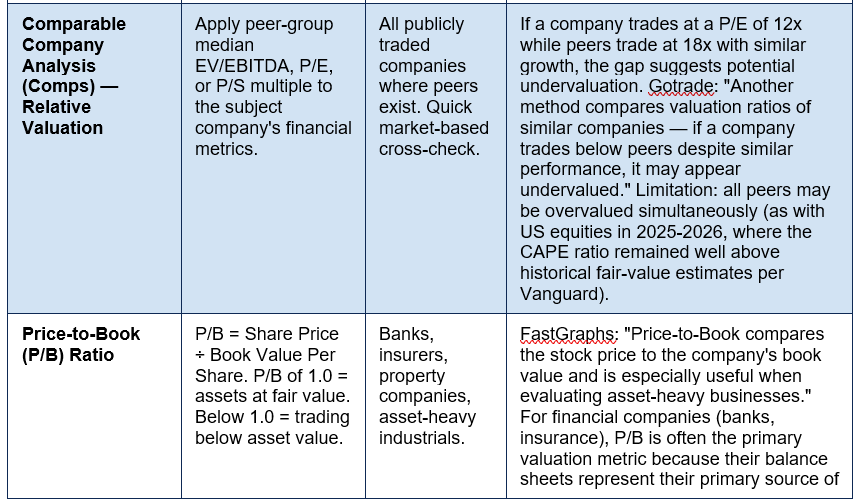
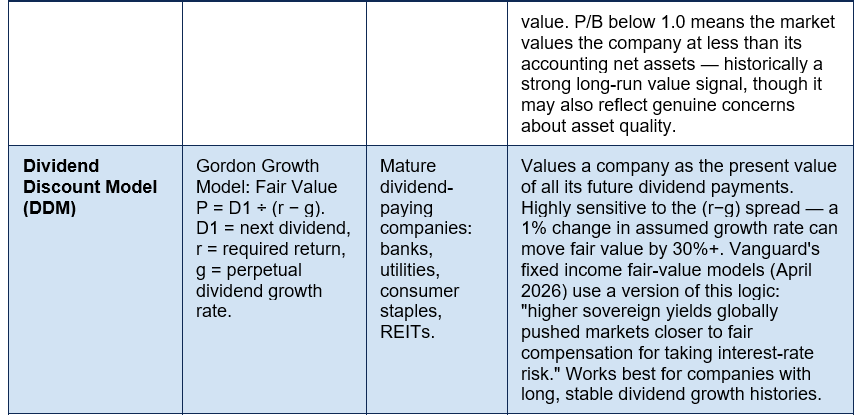
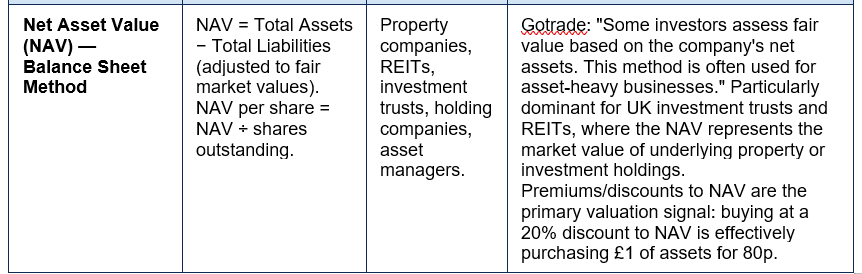
No single method of calculating fair value is universally superior — different methods are more appropriate for different types of companies and different analytical contexts. Professional investors typically triangulate between two or more methods, looking for convergence across approaches to build conviction. The six most important methods are: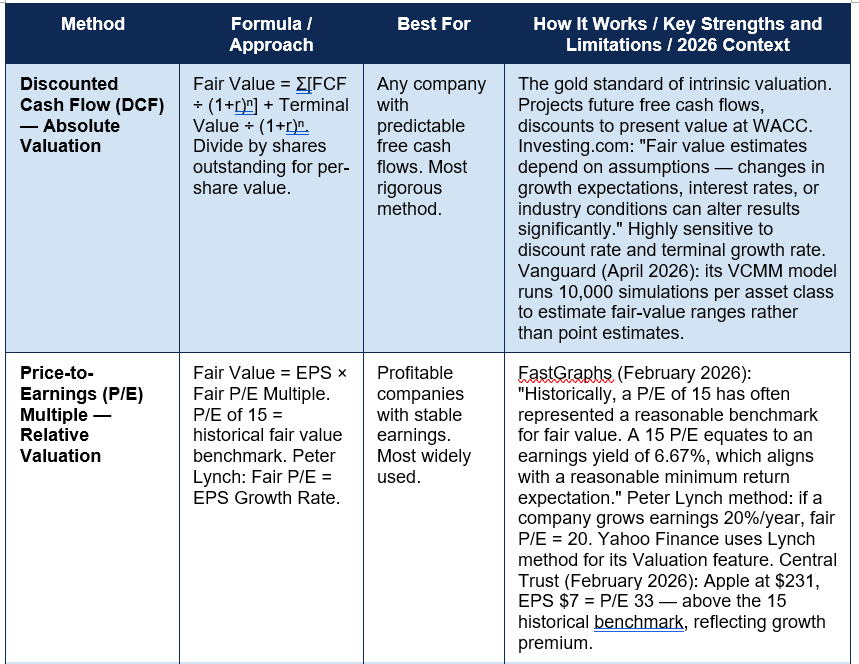
Worked Examples: Fair Value Calculation in Practice
Example 1 — Apple Inc: P/E Method (Central Trust, February 2026)
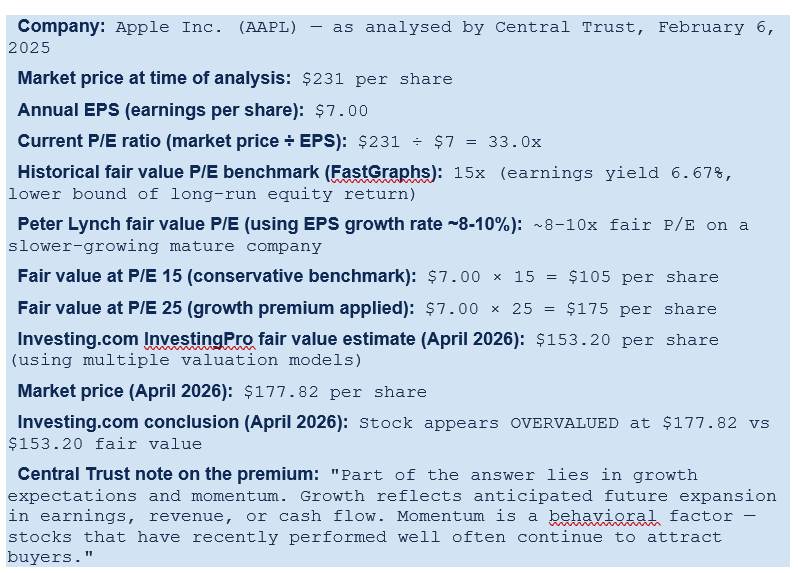
Example 2 — Hypothetical UK Mid-Cap: DCF and P/E Triangulation
This example illustrates the triangulation approach — using multiple methods to arrive at a fair value range rather than a single point estimate: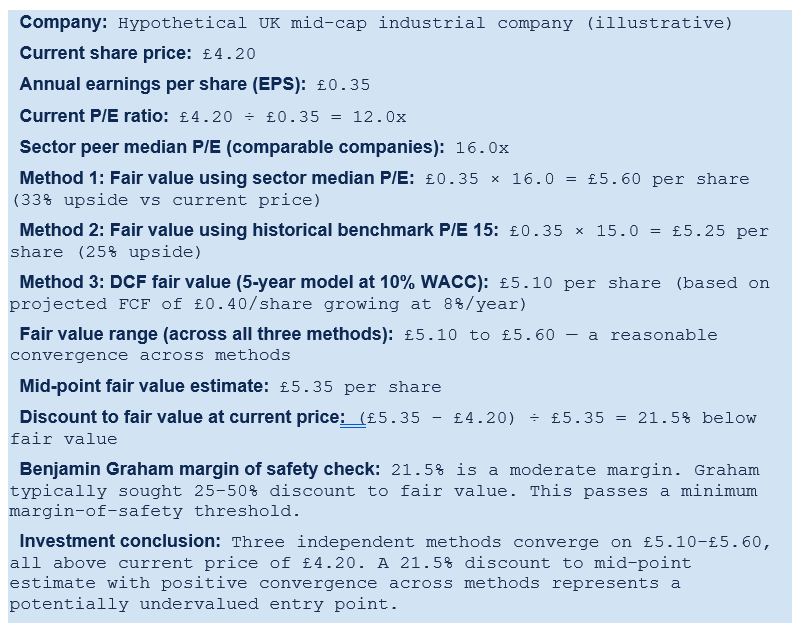
The Margin of Safety: Why Fair Value Alone Is Not Enough
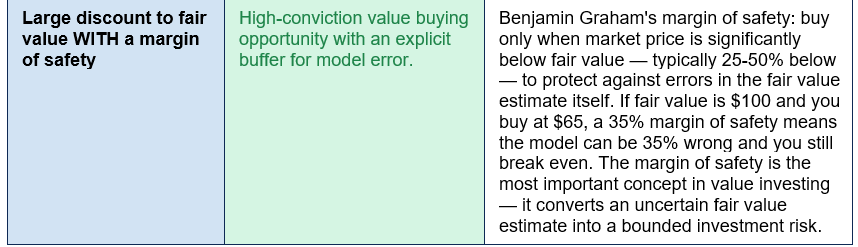
The fair value estimate is an imprecise output of an imprecise process. Even the most rigorous DCF model is based on projections of future cash flows that will never be perfectly accurate. The discount rate chosen reflects judgements about risk that are inherently uncertain. The comparable company multiples used reflect the current collective pricing of the market — which may itself be elevated or depressed. Given all this uncertainty, Benjamin Graham — the father of value investing and Warren Buffett's professor and mentor — argued that investors should only buy when the market price is significantly below their estimated fair value, providing a buffer against errors in their own analysis.This buffer is the margin of safety. Graham's principle: do not invest unless the market price is at least 25-50% below your best estimate of fair value. If you estimate a stock's fair value at £100 and buy at £65 (a 35% margin of safety), you have protected yourself against the possibility that your fair value estimate is 25% too high. Even if the true fair value is only £80 rather than £100, you have still bought at a meaningful discount to what the business is worth. The margin of safety converts an uncertain estimate into a bounded risk — the degree of error required to lose money on the investment is explicitly quantified before you commit capital.
The same logic applies in reverse at the top of the market: a stock trading 30% above fair value provides a 30% margin of downside if the market reverts to fundamental fair value — even if the business itself does not deteriorate at all. This is precisely the risk Vanguard identified in April 2026: US equities trading above CAPE fair value despite a 7% quarterly contraction meant that even the correction had not fully resolved the overvaluation relative to long-run fair value benchmarks.
THE MARGIN OF SAFETY FORMULA: Margin of Safety % = (Fair Value − Market Price) ÷ Fair Value × 100. Example: Fair value $100, market price $70. Margin of safety = ($100 − $70) ÷ $100 × 100 = 30%. Benjamin Graham's standard: seek at least 25-50% margin of safety before investing. Warren Buffett has refined this concept with the addition of "economic moat" — a business with durable competitive advantages (brand, patents, network effects, cost advantage) effectively has a wider intrinsic margin of safety because its fair value estimate is more likely to prove conservative than to prove optimistic. Buying a wide-moat business at fair value may be more prudent than buying a narrow-moat business at a 30% discount.
Fair Value vs Market Price: What the Gap Signals for Investors
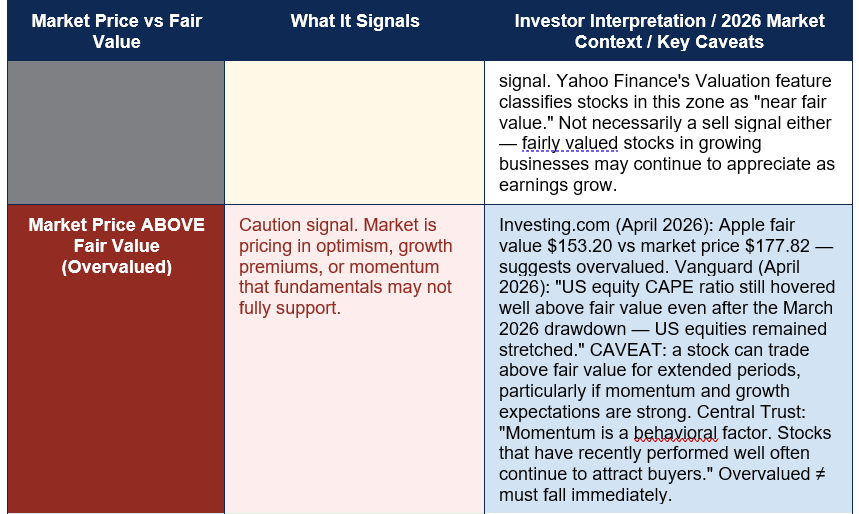
The relationship between a stock's market price and its estimated fair value is the primary signal that fair value analysis produces. The table below maps every price-to-fair-value scenario to its investment signal, the investor interpretation, and the key caveats for 2026: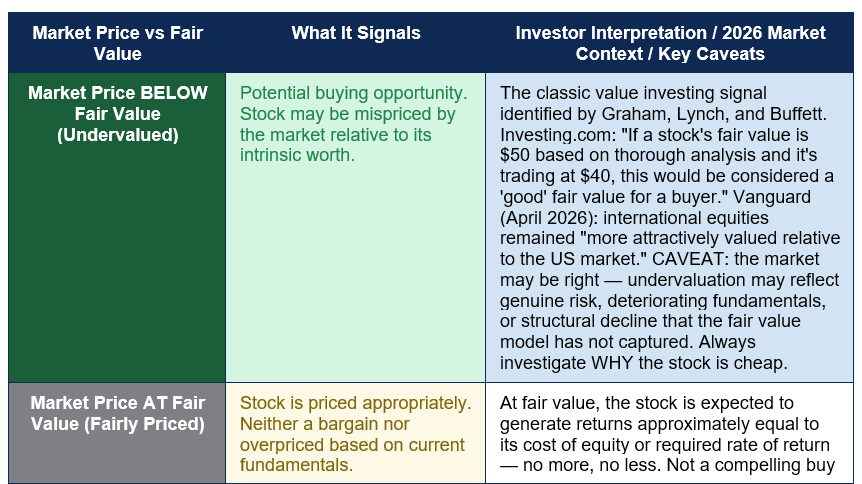
Fair Value and the 2026 Market: Where Are We Now?
The 2026 market environment provides a rich real-world context for fair value analysis across different asset classes. Vanguard's April 22, 2026 Capital Markets Model update — based on 10,000 VCMM simulations per asset class using data through March 31, 2026 — offers the most comprehensive current market-wide fair value assessment available from a major asset manager:- US equities remain elevated: Despite a 7% quarterly contraction in Q1 2026, the US CAPE ratio 'still hovered well above fair value' according to Vanguard. This means US broad-market equities are priced to deliver below-average long-run returns relative to their historical earnings power. Within US equities, value stocks and small-cap companies 'continued to offer more attractive valuations' — a finding consistent with the broader 2026 'anything but AI' rotation discussed across multiple market analyses.
- International equities more attractively valued: Vanguard's April 2026 assessment found that ex-US developed and emerging market equities 'remained more attractively valued relative to the US market.' International equities traded at lower multiples despite comparable or improving fundamentals — a condition that, over longer periods, is consistent with the mean-reversion in valuations that Vanguard notes tends to occur over 10+ year horizons.
- Fixed income approaching fair value: Higher sovereign yields globally 'pushed markets closer to fair compensation for taking interest-rate risk' in Vanguard's April 2026 analysis. Investment-grade bonds shifted 'from stretched to fairly valued' — meaning the yield on offer had risen to levels more consistent with historical fair compensation for duration and credit risk. This is a significant change from the 2021-2022 environment when bonds were systematically overvalued (yields too low) by the same framework.
- The Apple example — when growth premiums justify overvaluation: Investing.com's April 2026 analysis found Apple fair value at $153.20 versus market price $177.82 — approximately 16% above their estimated fair value. Central Trust's analysis adds essential nuance: 'Part of the answer lies in two additional factors that drive price beyond current fundamentals: growth expectations and momentum.' A stock can trade above its current-earnings-based fair value if the market is pricing in future earnings growth that the current P/E calculation does not capture. This is why many investors distinguish between current fair value (based on today's earnings) and forward fair value (based on projected future earnings).
Limitations of Fair Value: What It Cannot Tell You
Fair value analysis is a powerful tool but carries significant limitations that every investor must internalise:- Subjectivity in assumptions: Investing.com (April 2026) states the core limitation directly: 'Fair value depends on the assumptions and methods used, such as discounted cash flow or price-to-earnings ratios. Different analysts may arrive at varying results.' Two analysts building a DCF on the same company with different growth rate assumptions can produce fair values that differ by 50% or more. The fair value estimate is only as reliable as its inputs — and forecasting cash flows, margins, and growth rates years into the future is inherently uncertain.
- Dynamic and constantly changing: Investing.com: 'Fair value changes over time due to market conditions, economic factors, or company-specific developments, requiring frequent reassessment to remain relevant.' A fair value estimate based on last year's earnings and a 2% risk-free rate is meaningfully different from one recalculated with this year's earnings and a 5% risk-free rate. Higher interest rates reduce the present value of future cash flows and push fair values down — which is precisely why rising rates in 2022-2023 caused such severe declines in growth stock valuations.
- Markets can stay wrong for a very long time: Gotrade's February 2026 guide identifies the most practically frustrating limitation: 'Even if a stock appears undervalued based on fair value analysis, prices may remain disconnected longer than expected. Investor sentiment can drive prices beyond fundamentals during bubbles or downturns.' Legendary investor John Maynard Keynes captured this: 'The market can remain irrational longer than you can remain solvent.' Fair value tells you nothing about when the market will recognise the gap and close it.
- The market may be right: When a stock trades significantly below fair value, the first question should be 'why is it cheap?' rather than 'when will it recover?' The market may have identified risks that the fair value model has not captured: management problems, competitive disruption, regulatory headwinds, or balance sheet issues that are not fully visible in the published financial statements. A stock that appears to offer a 40% discount to fair value may be accurately priced if its future cash flows are about to deteriorate sharply.
- Historical P/E benchmarks change with interest rates: FastGraphs' P/E 15 as a fair value benchmark is derived from a particular historical interest rate environment. In a world of very low risk-free rates, a P/E of 20 or 25 may be justifiable. When risk-free rates rise significantly (as they did in 2022-2023), the fair P/E falls because the opportunity cost of holding equities versus bonds has increased. Central Trust: 'Discounted Cash Flow estimates future cash flows and discounts them to today's value using a risk-free rate, often the 10-year US Treasury yield' — the fair value derived from DCF moves inversely with the risk-free rate.
THE VALUE TRAP WARNING — WHEN CHEAP IS GENUINELY CHEAP FOR A REASON: One of the most common and most costly mistakes in fair value investing is buying stocks that appear to trade at large discounts to fair value but are in fact in structural decline. 'Value traps' look like bargains: low P/E ratios, large discounts to book value, high dividend yields. But they are cheap because the business is deteriorating — earnings are falling, the industry is being disrupted, management is destroying capital, or the dividend is about to be cut. The fair value model, based on current or recent earnings, looks attractive. But if those earnings are about to decline permanently, the true fair value is much lower than the model suggests. The most important question before buying any stock at a large discount to fair value is not 'what is the upside if it reverts to fair value?' but 'why is the market pricing it this way, and what does the market know that my model does not?'
Conclusion
Fair value is the estimated intrinsic worth of an asset based on its fundamental financial characteristics — earnings, cash flows, dividends, assets, and growth prospects — independent of whatever the market happens to be trading it for at any given moment. It is the foundational concept of fundamental investing, the framework through which value investors from Benjamin Graham to Warren Buffett have made their investment decisions, and the benchmarking tool through which institutions like Vanguard assess whether entire asset classes are attractively priced relative to their long-run return potential.The six methods for estimating fair value — discounted cash flow, P/E multiple, comparable company analysis, P/B ratio, dividend discount model, and net asset value — each capture a different dimension of fundamental worth. Professional investors triangulate across multiple methods, looking for convergence to build conviction. The worked example in this guide shows a UK mid-cap industrial where three methods converge on a £5.10-£5.60 range against a market price of £4.20 — a 21.5% discount to mid-point that meets the lower bound of Graham's margin of safety threshold. The Apple example from Investing.com (April 2026) shows the opposite: a stock at $177.82 against a $153.20 fair value estimate, trading at a premium that reflects growth expectations and momentum rather than current earnings power.
The Vanguard April 2026 market assessment crystallises where fair value analysis stands in 2026: US equities remain above CAPE fair value even after the Q1 correction; international equities are more attractively valued; and fixed income has moved from stretched to near-fair-value following rising yields. These are exactly the kinds of actionable, calibrated conclusions that fair value analysis is designed to produce — not precise predictions of what will happen next month, but structured, evidence-based perspectives on where the risk-return balance is more or less favourable over the long run. The limitation is equally important: overvalued markets can stay overvalued for years, and undervalued stocks can remain cheap far longer than seems rational. Fair value tells you where you stand; it does not tell you when the market will agree.
0 Comments
Be the first to share your thoughts on this article.