
Finance
Do Banks Refund Scammed Money? The UK Rules, Limits and Odds

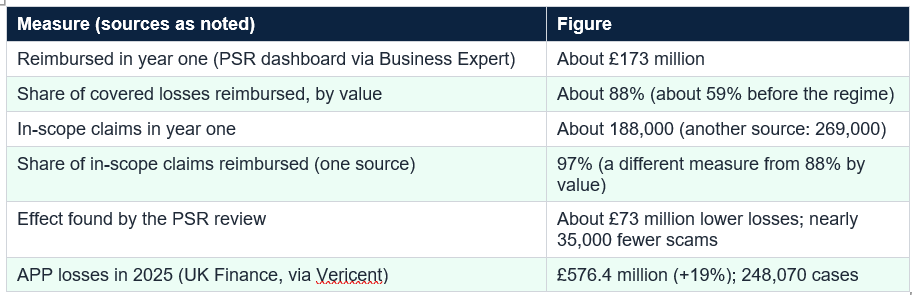
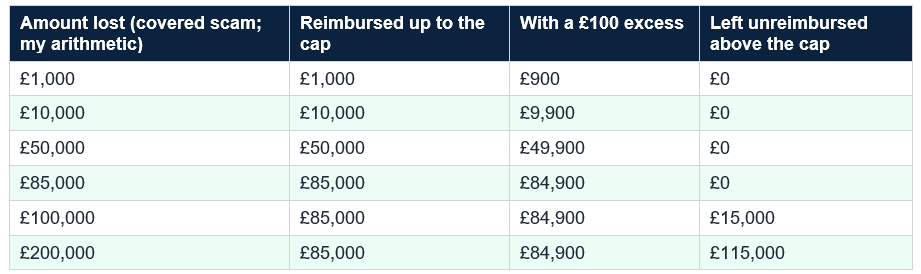
The rules (PSR): mandatory reimbursement for APP scams on Faster Payments and CHAPS since 7 October 2024; maximum £85,000 per claim (over 99% of claims); optional excess up to £100, not for vulnerable customers; cost split 50/50 between sending and receiving firms; Financial Ombudsman Service limit £430,000. The results: about £173 million reimbursed in the first year (October 2024 to September 2025), about 88% of covered losses by value, up from about 59% before; about 188,000 claims (another source says 269,000); PSR review: £73 million fewer losses and nearly 35,000 fewer scams; UK Finance: £576.4 million of APP losses in 2025 (+19%) across 248,070 cases. My arithmetic: on £10,000 stolen, 88% by value is £8,800 against £5,900 at 59%; a £100,000 loss returns £85,000 and leaves £15,000; on an £85,000 claim each firm pays £42,500; £173 million across 188,000 claims averages about £920.
That does not mean every victim is repaid in full, and it does not apply everywhere. This guide explains the UK rules, what the first-year numbers show, why a claim can fail, the answer for card payments and in the United States and what to do in the first hour after a scam, flagging where sources disagree. If you are in the middle of a scam, stop and call your bank now.
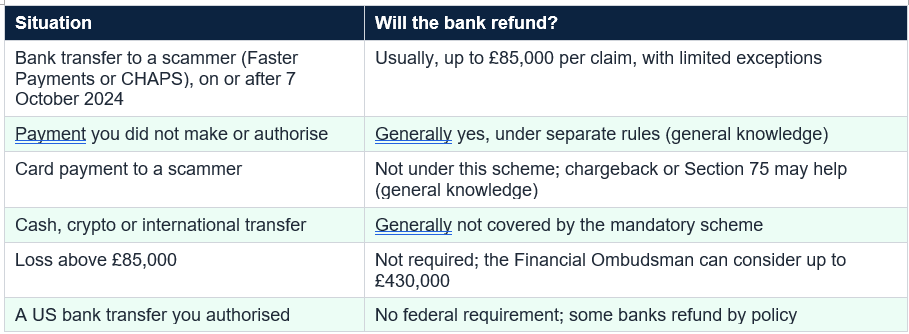
That is the gap the new scheme closes: firms must reimburse APP scams, rather than merely may. All types are covered, including impersonation and romance scams, according to the regulator. The rule applies to payments made on or after 7 October 2024; earlier losses fell under an older voluntary code, the Contingent Reimbursement Model, which was applied inconsistently, and if your scam was before that date the answer may differ, though you may still be able to complain to the Financial Ombudsman Service.
The cost is split 50/50 between the sending firm, where your account is, and the receiving firm, where the fraudster’s account is, according to several sources, so on an £85,000 claim each pays £42,500, which encourages receiving firms to police the accounts they open. The scheme covers consumers and, according to one source, small businesses. Sources describe a decision within five working days of a claim, which I could not verify in the rule text. Above £85,000 you can go to the Financial Ombudsman Service, which can award up to £430,000.
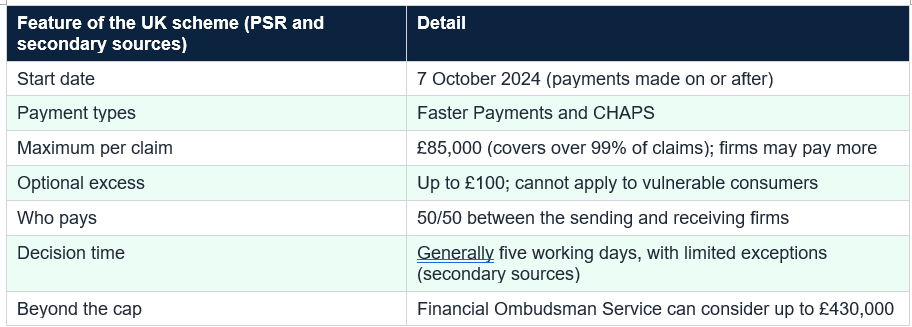
PSR: mandatory APP reimbursement from 7 October 2024; up to £85,000 per claim (over 99% of claims); optional excess up to £100 (not for vulnerable customers); Financial Ombudsman limit £430,000. Year one: about £173 million reimbursed, about 88% of covered losses by value (59% before).
But the picture is mixed. UK Finance’s Annual Fraud Report, published in June 2026, shows APP losses of £576.4 million in 2025, up 19%, across 248,070 cases, about £2,300 a case, according to a secondary summary; these are gross losses before reimbursement, and reimbursement does not stop the crime. One source cites reimbursement of 97% of in-scope claims, a different measure from 88% by value, and sources differ on claim counts (188,000 or 269,000), so treat each number as approximate. The direction is clear: victims now get much more money back.
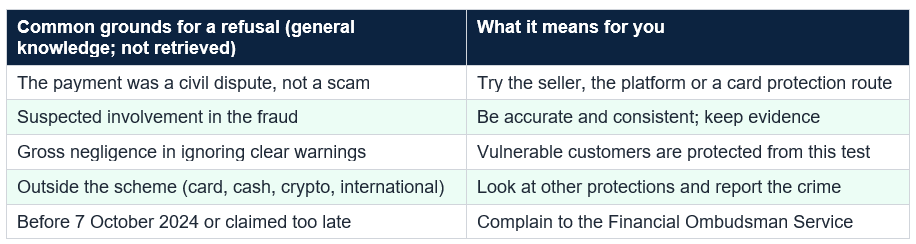
Other reasons are practical: the payment was outside the scheme (card, cash, crypto or international), was made before 7 October 2024 or was claimed too late, with a time limit I understand to be 13 months. If your bank refuses, ask for its reasons in writing and complain to the Financial Ombudsman Service, and keep every message, screenshot and receipt, since your account of what happened and any warnings you saw will matter.
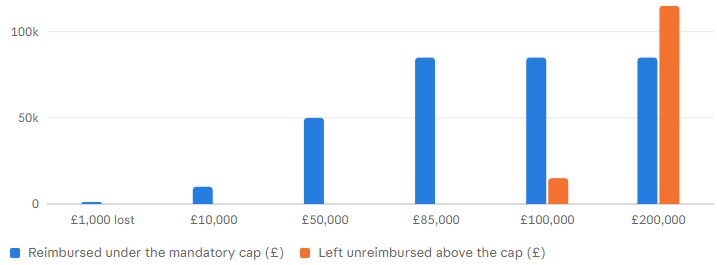
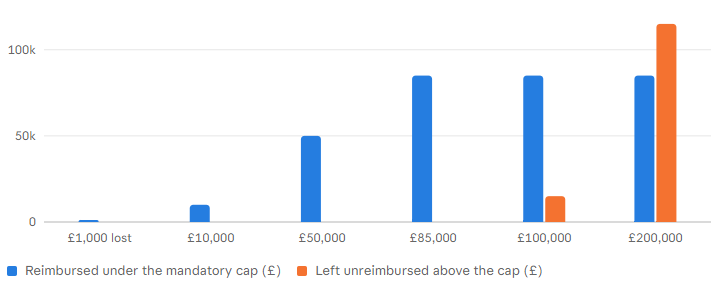
A £200,000 loss, for instance from a house-purchase scam, returns £85,000, leaving £115,000 to pursue through the Ombudsman (up to £430,000) or the courts against the fraudster, usually unrecoverable. These cases are rare, since the regulator says the cap covers over 99% of claims, but the largest losses, which tend to be property and investment scams, can fall partly outside the scheme, and if that is you, take advice.
Cash, gift cards and cryptocurrency are harder: once sent, they are usually very difficult to trace and recover, and these payments are generally outside the mandatory scheme. International transfers from a UK account may also fall outside it, although one source says you can still use the Ombudsman for the bank’s conduct. Always report the scam to your bank and to Action Fraud, even if reimbursement looks unlikely.
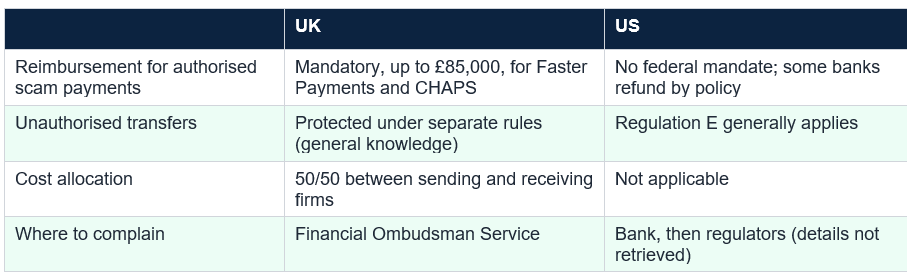
That does not mean US banks never help: some refund scam victims as a matter of policy and some can recall a payment if you act quickly, though I did not retrieve details. The key difference is that in the UK reimbursement is a legal obligation for most bank-transfer scams, while in the US it is often discretionary. If you are in the US, report the scam at once and ask your bank what it can do.
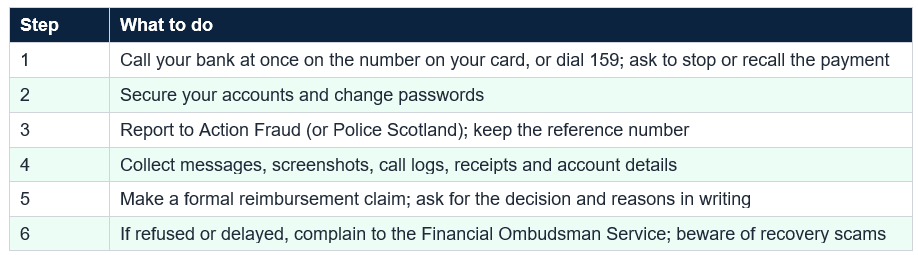
Fifth, make a formal reimbursement claim and ask for the decision and reasons in writing; in my general knowledge you generally have 13 months, but the sooner the better. Sixth, if the bank refuses or delays, complain to the Financial Ombudsman Service, which is free. And be wary of recovery scams, where fraudsters target victims again by offering to recover lost money for a fee.
Save 159 in your phone today. If anyone calls claiming to be your bank, hang up, wait a minute, and call 159 or the number on your card, never one the caller gives you.
Read any warning your bank shows when you make a payment, since ignoring clear ones can weaken a claim. These scams are common: UK Finance reported £576.4 million of APP losses in 2025, up 19%. Being tricked does not mean you were foolish, since fraudsters are professionals, but acting quickly is still your best protection.
Common mistakes include waiting before reporting, trusting a caller who says they are from your bank, calling back on a number the caller gave you, ignoring on-screen warnings, assuming the bank will not help because you made the payment yourself, not keeping evidence, accepting a first refusal without complaining to the Ombudsman and falling for recovery scams. Cards, cash and crypto sit outside the scheme.
In the US there is no equivalent federal rule, so the answer is often less certain. Wherever you are, the first hour matters: call your bank on a trusted number, dial 159 in the UK, report to the police or Action Fraud, gather evidence and make a formal claim, and if you are refused, the Financial Ombudsman Service can help. The best defence is a pause before any urgent payment.
In the UK, often yes. Since 7 October 2024, payment firms must reimburse most victims of authorised push payment (APP) scams on Faster Payments and CHAPS transfers, up to £85,000 per claim, according to the Payment Systems Regulator. In the first year, firms paid back about £173 million, roughly 88% of covered losses by value. But some cases are excluded, such as card payments, cash, crypto and certain disputes, and a few claims are refused.
How much can I get back?
Up to £85,000 per claim under the mandatory scheme, which the regulator says covers over 99% of claims. Firms may apply an optional excess of up to £100, except for vulnerable customers, and may choose to pay more than £85,000. If you lose more and are not reimbursed, you can take the case to the Financial Ombudsman Service, which can award up to £430,000.
How quickly should the bank pay?
Sources describe a decision and payment within five working days of a claim, generally, subject to limited exceptions. In my general knowledge, the clock can be paused if the firm needs more information, but I did not retrieve the rule text. If your bank is slow or refuses, ask for the decision in writing and the reasons, and consider the Financial Ombudsman Service.
What if I paid by card, cash or crypto?
The mandatory scheme covers Faster Payments and CHAPS transfers, not card payments, cash or crypto purchases. Card payments may have other protections, such as chargeback or, for purchases between £100 and £30,000 on a credit card, Section 75, which I note from general knowledge. Cash and crypto losses are usually much harder to recover. Check what protections apply to the way you paid.
Do US banks refund scammed money?
Not necessarily. There is no federal rule making a US bank reimburse a customer who authorised a scam payment, and Regulation E mainly covers transfers initiated by someone else, according to one analysis. A regulator’s lawsuit against the operator of Zelle and three banks was voluntarily dismissed in March 2025. Some banks refund as a matter of policy, so report the scam and ask. This is general information, not personal advice.
Table of Contents
- The Question Everyone Asks
- The Short Answer
- Authorised or Unauthorised? Why It Matters
- The UK Rules in Plain English
- What the Results Show So Far
- When a Refund Can Fail
- Worked Examples: How Much Comes Back
- Cards, Cash, Crypto and Other Payments
- The US: A Different Answer
- What to Do in the First Hour
- Reducing Your Risk
- Common Mistakes
- Conclusion
- Frequently Asked Questions
How much comes back: the 385,000 cap on scams of different sizes
Pounds (£) by Author's arithmetic from the PSR's published £85,000 maximum; ignores the optional excess of up to £100 and any firm choosing to pay more; the Financial Ombudsman can consider losses above the cap up to £430,000
How much comes back: the £85,000 cap on scams of different sizes (£)
Pounds (£) by Author's arithmetic from the PSR's published £85,000 maximum; ignores the optional excess of up to £100 and any firm choosing to pay more; the Financial Ombudsman can consider losses above the cap up to £430,000
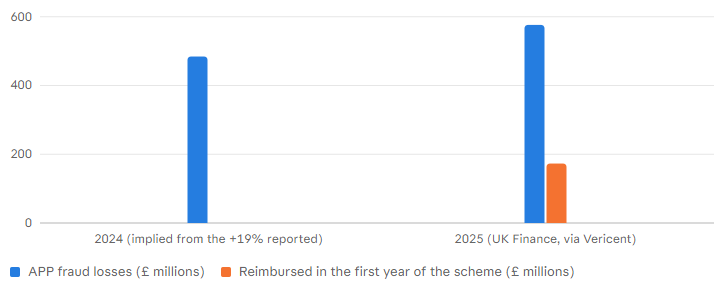
Scams are still rising: UK APP fraud losses, 2024 vs. 2025 (£ millions)
£ millions by UK Finance Annual Fraud Report 2026 via Vericent: 576.4 million pounds in 2025, up 19% (2024 is the author's implied figure, 576.4 / 1.19); the 173 million reimbursed covers October 2024 to September 2025, a different period; gross losses before reimbursement
The Question Everyone Asks
If you have just been scammed, one question fills your head: will I get my money back? The honest answer has changed. A few years ago, victims of bank-transfer scams were often told that because they made the payment themselves, the bank owed them nothing. In the UK that is no longer the starting point: a mandatory scheme, run through the Payment Systems Regulator, obliges banks and other payment firms to reimburse most victims of this kind of fraud.That does not mean every victim is repaid in full, and it does not apply everywhere. This guide explains the UK rules, what the first-year numbers show, why a claim can fail, the answer for card payments and in the United States and what to do in the first hour after a scam, flagging where sources disagree. If you are in the middle of a scam, stop and call your bank now.
The Short Answer
In the UK, often yes. Since 7 October 2024, payment firms must reimburse most victims of authorised push payment (APP) scams on Faster Payments and CHAPS transfers, up to £85,000 per claim, generally within five working days. In the first year firms paid back about £173 million, roughly 88% of covered losses by value, up from about 59% before. But there are limits: card, cash and crypto payments are outside the scheme, a few claims are refused, an optional £100 excess may apply and losses above £85,000 are not covered unless the firm chooses to pay more. In the US there is no equivalent federal rule.
Authorised or Unauthorised? Why It Matters
The rules turn on one distinction: did you make the payment, or did someone else? Unauthorised fraud is when a criminal takes money from your account without your permission, for example by stealing your card details, and you have always had stronger protection there. Authorised push payment fraud is different: you are tricked into sending the money yourself, perhaps by someone pretending to be your bank, a police officer or a trader. You log in and press send, so historically the bank could say you authorised it.That is the gap the new scheme closes: firms must reimburse APP scams, rather than merely may. All types are covered, including impersonation and romance scams, according to the regulator. The rule applies to payments made on or after 7 October 2024; earlier losses fell under an older voluntary code, the Contingent Reimbursement Model, which was applied inconsistently, and if your scam was before that date the answer may differ, though you may still be able to complain to the Financial Ombudsman Service.
The UK Rules in Plain English
The maximum claim is £85,000, which the Payment Systems Regulator says covers over 99% of claims, although firms may choose to pay more: in one case reported by Edgar, Dunn & Company, a bank repaid a vulnerable customer the full £100,000. Firms may apply an optional excess of up to £100, or a lower amount, or none, but cannot apply it to vulnerable customers.The cost is split 50/50 between the sending firm, where your account is, and the receiving firm, where the fraudster’s account is, according to several sources, so on an £85,000 claim each pays £42,500, which encourages receiving firms to police the accounts they open. The scheme covers consumers and, according to one source, small businesses. Sources describe a decision within five working days of a claim, which I could not verify in the rule text. Above £85,000 you can go to the Financial Ombudsman Service, which can award up to £430,000.
PSR: mandatory APP reimbursement from 7 October 2024; up to £85,000 per claim (over 99% of claims); optional excess up to £100 (not for vulnerable customers); Financial Ombudsman limit £430,000. Year one: about £173 million reimbursed, about 88% of covered losses by value (59% before).
What the Results Show So Far
In the first full year, October 2024 to September 2025, firms reimbursed about £173 million, roughly 88% of covered losses by value, across around 188,000 claims, according to the PSR’s dashboard as summarized by Business Expert. Before the mandatory rules the voluntary code repaid about 59% by value, according to one source, so on £10,000 stolen, 88% is £8,800 against £5,900, a difference of £2,900 in my arithmetic. One source adds that the PSR’s own review found the scheme cut losses by about £73 million and scam volumes by nearly 35,000.But the picture is mixed. UK Finance’s Annual Fraud Report, published in June 2026, shows APP losses of £576.4 million in 2025, up 19%, across 248,070 cases, about £2,300 a case, according to a secondary summary; these are gross losses before reimbursement, and reimbursement does not stop the crime. One source cites reimbursement of 97% of in-scope claims, a different measure from 88% by value, and sources differ on claim counts (188,000 or 269,000), so treat each number as approximate. The direction is clear: victims now get much more money back.
When a Refund Can Fail
Most claims succeed, but some do not. In my general knowledge (not retrieved from the rule text), the main grounds are these: the claim is not really an APP scam, for example a civil dispute with a genuine seller over quality or delivery; the customer is suspected of being involved in the fraud (first-party fraud); or, under the scheme’s standard of caution, the customer ignored clear warnings with gross negligence, though vulnerable customers are protected from that test.Other reasons are practical: the payment was outside the scheme (card, cash, crypto or international), was made before 7 October 2024 or was claimed too late, with a time limit I understand to be 13 months. If your bank refuses, ask for its reasons in writing and complain to the Financial Ombudsman Service, and keep every message, screenshot and receipt, since your account of what happened and any warnings you saw will matter.
Worked Examples: How Much Comes Back
Here is how the cap and excess work, using the published rules and my arithmetic. A £1,000 loss to a covered scam could be repaid in full, or £900 if your bank applies a £100 excess; £10,000 could return £10,000, or £9,900 with the excess; and an £85,000 claim is paid in full, with each firm bearing £42,500. But a £100,000 loss returns £85,000 under the mandatory rules, leaving £15,000, unless the bank chooses to pay more or the Financial Ombudsman says it should.A £200,000 loss, for instance from a house-purchase scam, returns £85,000, leaving £115,000 to pursue through the Ombudsman (up to £430,000) or the courts against the fraudster, usually unrecoverable. These cases are rare, since the regulator says the cap covers over 99% of claims, but the largest losses, which tend to be property and investment scams, can fall partly outside the scheme, and if that is you, take advice.
Cards, Cash, Crypto and Other Payments
The mandatory scheme is specific to bank transfers on Faster Payments and CHAPS. If you paid by debit or credit card, different protections apply: in my general knowledge you may be able to dispute the payment through your card provider (a chargeback), and for credit card purchases between £100 and £30,000 Section 75 of the Consumer Credit Act can make the card company jointly liable. These routes depend on the facts and are not guaranteed.Cash, gift cards and cryptocurrency are harder: once sent, they are usually very difficult to trace and recover, and these payments are generally outside the mandatory scheme. International transfers from a UK account may also fall outside it, although one source says you can still use the Ombudsman for the bank’s conduct. Always report the scam to your bank and to Action Fraud, even if reimbursement looks unlikely.
The US: A Different Answer
In the United States the answer is less generous. One analysis says there is no US equivalent of the UK scheme: no federal rule makes a bank reimburse a customer who authorised a scam payment. Regulation E mainly protects customers against transfers initiated by someone else, for example when a login is stolen, not those where the customer was tricked into paying. The same analysis notes the Consumer Financial Protection Bureau sued the operator of Zelle and three banks, and the case was voluntarily dismissed on 4 March 2025.That does not mean US banks never help: some refund scam victims as a matter of policy and some can recall a payment if you act quickly, though I did not retrieve details. The key difference is that in the UK reimbursement is a legal obligation for most bank-transfer scams, while in the US it is often discretionary. If you are in the US, report the scam at once and ask your bank what it can do.
What to Do in the First Hour
Speed matters. First, contact your bank immediately, using the number on the back of your card or by dialling 159, the service that connects you to your bank securely, and ask it to stop or recall the payment and freeze anything else at risk. Second, change passwords and secure your accounts if you shared details. Third, report it to Action Fraud (England, Wales and Northern Ireland) or Police Scotland, and keep the reference number. Fourth, gather evidence: messages, call logs, screenshots, account details and receipts.Fifth, make a formal reimbursement claim and ask for the decision and reasons in writing; in my general knowledge you generally have 13 months, but the sooner the better. Sixth, if the bank refuses or delays, complain to the Financial Ombudsman Service, which is free. And be wary of recovery scams, where fraudsters target victims again by offering to recover lost money for a fee.
Save 159 in your phone today. If anyone calls claiming to be your bank, hang up, wait a minute, and call 159 or the number on your card, never one the caller gives you.
Reducing Your Risk
Prevention beats reimbursement. Be suspicious of any unexpected call, text or email that creates urgency, especially one asking you to move money to a “safe account,” which no genuine bank or police officer will ask. Hang up and call back on a number you know is genuine, check payee details and any confirmation-of-payee mismatch warning, take your time with large payments such as for a house or investment and verify the recipient independently.Read any warning your bank shows when you make a payment, since ignoring clear ones can weaken a claim. These scams are common: UK Finance reported £576.4 million of APP losses in 2025, up 19%. Being tricked does not mean you were foolish, since fraudsters are professionals, but acting quickly is still your best protection.
Common mistakes include waiting before reporting, trusting a caller who says they are from your bank, calling back on a number the caller gave you, ignoring on-screen warnings, assuming the bank will not help because you made the payment yourself, not keeping evidence, accepting a first refusal without complaining to the Ombudsman and falling for recovery scams. Cards, cash and crypto sit outside the scheme.
Conclusion
So, do banks refund scammed money? In the UK, most of the time, for bank-transfer scams. Since 7 October 2024, payment firms must reimburse most victims of authorised push payment fraud on Faster Payments and CHAPS, up to £85,000 per claim, with the cost split 50/50 between the sending and receiving firms. In the first year, about £173 million was repaid, roughly 88% of covered losses by value, up from about 59%. But the scheme has limits: an optional £100 excess, a £85,000 cap, exclusions for card, cash, crypto and some disputes, and a few refusals.In the US there is no equivalent federal rule, so the answer is often less certain. Wherever you are, the first hour matters: call your bank on a trusted number, dial 159 in the UK, report to the police or Action Fraud, gather evidence and make a formal claim, and if you are refused, the Financial Ombudsman Service can help. The best defence is a pause before any urgent payment.
Frequently Asked Questions
Do banks refund money lost to scams?In the UK, often yes. Since 7 October 2024, payment firms must reimburse most victims of authorised push payment (APP) scams on Faster Payments and CHAPS transfers, up to £85,000 per claim, according to the Payment Systems Regulator. In the first year, firms paid back about £173 million, roughly 88% of covered losses by value. But some cases are excluded, such as card payments, cash, crypto and certain disputes, and a few claims are refused.
How much can I get back?
Up to £85,000 per claim under the mandatory scheme, which the regulator says covers over 99% of claims. Firms may apply an optional excess of up to £100, except for vulnerable customers, and may choose to pay more than £85,000. If you lose more and are not reimbursed, you can take the case to the Financial Ombudsman Service, which can award up to £430,000.
How quickly should the bank pay?
Sources describe a decision and payment within five working days of a claim, generally, subject to limited exceptions. In my general knowledge, the clock can be paused if the firm needs more information, but I did not retrieve the rule text. If your bank is slow or refuses, ask for the decision in writing and the reasons, and consider the Financial Ombudsman Service.
What if I paid by card, cash or crypto?
The mandatory scheme covers Faster Payments and CHAPS transfers, not card payments, cash or crypto purchases. Card payments may have other protections, such as chargeback or, for purchases between £100 and £30,000 on a credit card, Section 75, which I note from general knowledge. Cash and crypto losses are usually much harder to recover. Check what protections apply to the way you paid.
Do US banks refund scammed money?
Not necessarily. There is no federal rule making a US bank reimburse a customer who authorised a scam payment, and Regulation E mainly covers transfers initiated by someone else, according to one analysis. A regulator’s lawsuit against the operator of Zelle and three banks was voluntarily dismissed in March 2025. Some banks refund as a matter of policy, so report the scam and ask. This is general information, not personal advice.
0 Comments
Be the first to share your thoughts on this article.