

Financial Literacy
Whose Definition of Financial Success Are You Chasing?
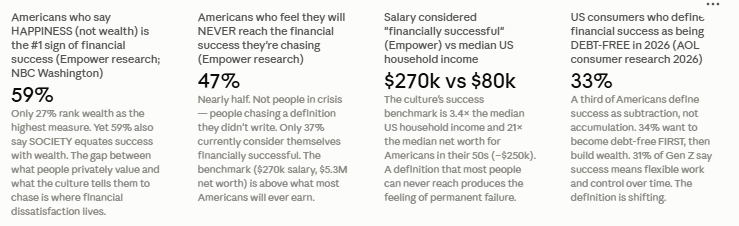
59% of Americans say happiness is the most important benchmark of financial success. Just 27% say it’s wealth. Yet 47% feel they’ll never reach the financial success they’re chasing — and the average number they consider ‘successful’ is $270,000 per year and $5.3 million in net worth. Something doesn’t add up. The mismatch is the point. Most of us are chasing someone else’s definition of success — one that is largely borrowed, externally validated, and quietly moving every time we get close.
There is a specific financial anxiety that has very little to do with the actual numbers in your bank account. It is the nagging, persistent sense that whatever you have is not enough — not enough saved, not enough earned, not enough progress toward something that feels, frustratingly, like it keeps moving further away. If you have experienced this, you are not alone, and you are not broken. You are, most likely, chasing a definition of financial success that was never yours to begin with.
The Empower research into how Americans define financial success produced a number that should stop everyone: 47% of Americans feel they will never achieve the level of financial success they are seeking. Nearly half. Not people who are destitute, not people who are in crisis — just people who have absorbed a definition of success they cannot reach, and are watching it from a distance and feeling like failures for not closing the gap.
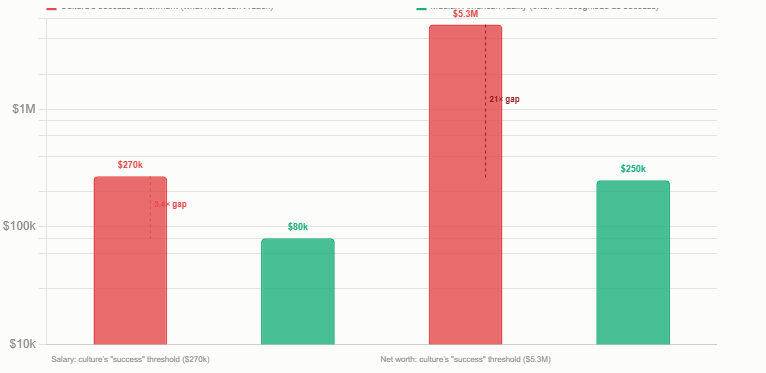
The same research reveals the specific magnitude of the gap. The average salary that Americans consider ‘financially successful’ is $270,000 per year. The average net worth: $5.3 million. These are not numbers that most Americans will ever reach. The median US household income is approximately $80,000. The median net worth of Americans in their 50s is approximately $250,000. If success means $270,000 and $5.3 million, then the vast majority of Americans will spend their entire lives feeling like they have not made it — regardless of whether they have built a genuinely good, financially stable, and deeply satisfying life.
This is the mismatch. And the mismatch is not a personal failure. It is a structural feature of a financial culture that has outsourced the definition of success to someone else — to media, to advertising, to social comparison, to an inherited story about what ‘enough’ looks like that was never interrogated or chosen.
47% of Americans feel they will NEVER achieve the level of financial success they're seeking (Empower, 'Secret to Success' research). 37% currently consider themselves financially successful. Average 'successful' salary: $270,000/year. Average 'successful' net worth: $5.3 million. Median US household income: ~$80,000/year. The gulf between the average definition of success and the median American's reality is approximately 3.4x salary and 21x net worth. Yet 59% say happiness (not wealth) is their real benchmark. The contradiction is the insight. Sources: Empower research; Benzinga; NBC Washington; Audacy.
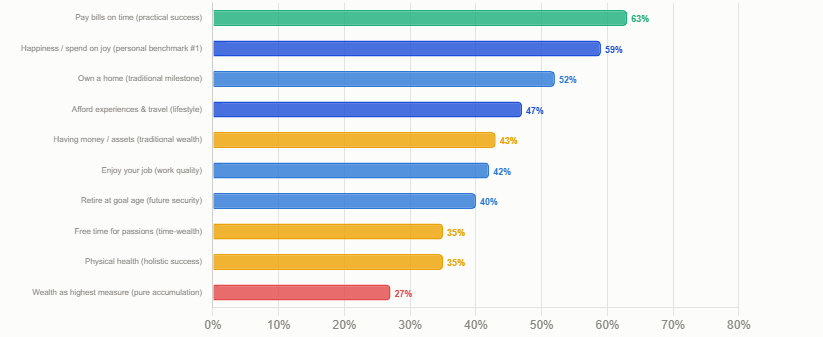
Fifty-nine per cent of Americans say happiness is the most important benchmark of financial success — specifically, the ability to spend money on the things and experiences that bring them joy. Only 27% rank wealth as the highest measure. The gap between what people privately believe success means and what they perceive society believes is enormous: 59% say society equates success with wealth, 44% say society equates it with power, and 35% say society equates it with fame. Yet when asked what they personally value, just 6% say power matters to them at all.
The Charles Schwab Modern Wealth Survey produced a similar finding from a different angle. When asked what contributes most to their personal definition of wealth, survey respondents ranked happiness (45%) and amount of money (44%) in an essentially equal tie. Physical health came in at 37%, mental health at 32%, quality of relationships at 24%, and life experiences at 24%. Wealth, by any conventional definition, is barely the leading factor in how Americans define wealth.
In concrete terms, the Empower research found that financial success most commonly shows up as paying bills on time (63%), owning a home (52%), and being able to afford experiences like travel and entertainment (47%). Forty-two percent cite enjoying their job. Forty percent cite retiring at a goal age. These are not $5.3 million benchmarks. These are reachable, human-scale achievements — achievements that many Americans have already made without recognising them as success because they have been measuring against the wrong ruler.
The most important finding in the Empower research is not any individual percentage. It is the structural contradiction at the centre of the data: Americans say happiness is success; 59% also say society defines success as wealth; 47% feel they will never reach their own definition of success. The conclusion is that most people are not chasing their own definition. They are chasing the one they believe they are supposed to want. Understanding this distinction is the beginning of meaningful personal finance.
For many people, the framework is generational comparison. Fifty per cent of Americans in the Empower research say they are or expect to be better off financially than their parents — and this is still used as a baseline measure of success. For generations where homeownership was achievable on a single income and retirement was funded by a defined-benefit pension, the comparison may feel like a rebuke. For younger generations navigating student debt, housing costs that have outpaced wage growth, and a shift from pensions to self-funded 401(k) accounts, matching the previous generation’s financial milestones requires different tools and a different mental model.
The media layer adds another filter. Financial media, wealth content, and investment content tend to platform the outliers — the early retirees, the millionaires who made it at 35, the founders who exited at 40. These are genuinely interesting stories. They are not, however, statistically representative of financial outcomes. Consuming them regularly without calibrating for their selection bias builds a distorted mental picture of what normal financial progress looks like at any age.
Then there is the income peer group. Research on subjective wellbeing consistently finds that people evaluate their financial situation not against an absolute standard but against the people around them. A household earning $120,000 in a neighbourhood where the median income is $200,000 feels behind. The same household in a neighbourhood where the median income is $60,000 feels ahead. Same money. Different emotional experience. The definition of financial success is doing almost all the work in both cases, and the definition is not self-authored.
The cost of an externally sourced financial success definition is not primarily financial. It is psychological. Running toward a target that is set by someone else — or by an aggregated cultural expectation of what success looks like — means the goalpost moves as you approach it. The person chasing $270,000 who reaches $270,000 often discovers that the relevant comparison group now earns $350,000. The person who reaches $5.3 million in net worth encounters a community where $10 million is the reference point. This is not cynicism. It is a documented feature of what psychologists call the hedonic treadmill applied to financial status. The solution is not to earn more. It is to redefine.
The most tangible version of this is lifestyle inflation calibrated to peer groups rather than personal meaning. A household that buys a larger home than they need because the definition of success in their social circle includes a specific square footage is not allocating capital optimally. A professional who upgrades to a luxury car when a practical vehicle would serve the same function, because the luxury car signals the level of success they believe they need to project, is paying what might be called the society tax: the premium applied to purchases when social perception, rather than genuine utility, drives the decision.
The society tax shows up in different places at different income levels. At lower incomes, it may be the pressure to spend on branded items or to participate in social activities beyond one’s budget. At middle incomes, it is often private school fees, home renovation cycles, and vacation standards set by peer group rather than personal preference. At high incomes, it is the progression from adequate to aspirational to prestigious — a progression that has no natural endpoint and consumes an increasing fraction of income with diminishing returns on genuine wellbeing.
What makes this particularly costly is that the society tax is invisible in most financial plans. It does not appear as a line item. It is embedded in housing decisions, car decisions, clothing decisions, travel decisions — in the accumulated premium between what you would genuinely choose if nobody were watching and what you choose when the choice is visible to the peer group whose opinion shapes your definition of success.
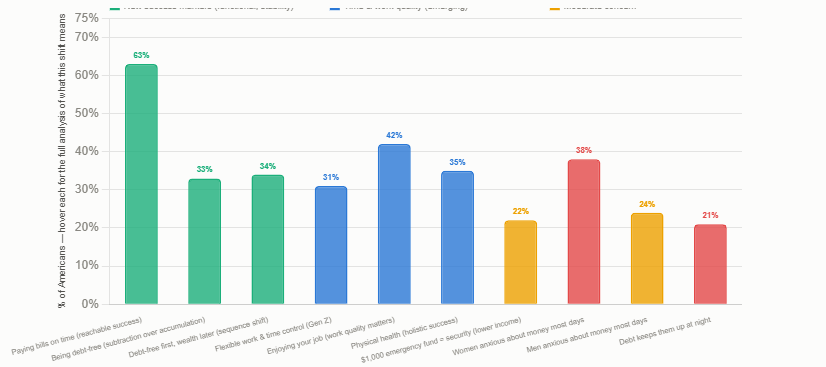
This shift makes intuitive sense in a financial environment where the average American carries student loan debt, credit card balances, and a mortgage simultaneously. Debt is not merely a financial obligation. As the AOL research notes directly: ‘Debt is not merely a balance sheet item. It is psychological weight.’ The 21% of lower-income consumers who say debt keeps them up at night are not experiencing a financial problem in the abstract. They are living its physical and emotional texture every day.
Defining success as debt freedom is a meaningful reorientation of the financial goal-setting process. Instead of asking ‘how much do I need to accumulate?’ — a question with a moving answer driven by comparison — the debt-freedom framework asks ‘what obligations am I carrying that reduce my autonomy and increase my anxiety?’ and sets the goal as eliminating them. The answer to that question is concrete, measurable, and entirely personal. It does not depend on what anyone else earns or owns.
The fact that 22% of consumers earning under $50,000 say a $1,000 emergency fund would make them feel secure is another version of the same insight. For that population, success is not $5.3 million in net worth. It is $1,000 in a savings account that provides a buffer against the next unexpected car repair or medical bill. That is a valid, real, and meaningful financial success. The definition the broader culture offers makes it invisible.
The debt-free standard and the emergency fund standard are not lesser definitions of financial success. They are more precise ones. They answer the question 'what would make my financial life feel different tomorrow?' rather than 'what would make it feel successful according to a benchmark I absorbed from media?' Both are legitimate orientations. Only one of them produces a goal you might actually reach and recognise when you do.
The conventional financial success narrative is built on capital accumulation: earn money, save money, invest money, accumulate enough to stop needing to earn money. Time is implicitly something you spend in the service of capital accumulation until the capital is sufficient to stop requiring your time. The Gen Z reorientation reverses the relationship: time is the primary resource, and money is valuable to the extent that it purchases or protects time.
This is not a naive position. It has a rigorous formulation: the utility of money is not linear. Research consistently finds that above approximately $75,000 to $100,000 in annual household income (a figure that varies by location and family size), additional income produces diminishing gains in day-to-day emotional wellbeing — though it continues to improve evaluative wellbeing (how satisfied people feel with their overall life when asked directly). The implication is that beyond a certain income threshold, trading time for money produces progressively less wellbeing return per dollar earned.
A person earning $90,000 with full schedule control, minimal commute, and the ability to structure their day around personal priorities may experience higher subjective financial wellbeing than a person earning $180,000 with a rigid schedule, long commute, and minimal flexibility — even if every standard financial metric would rank the latter as more successful. The definition of financial success that ignores the time dimension is missing more than half of the picture.
The Empower research found that 35% of Americans cite free time to pursue personal passions as a top indicator of financial success — equal to physical health and more common than any wealth metric. The definition of success is already incorporating time for a substantial portion of the population. The question is whether the financial plan reflects that priority.
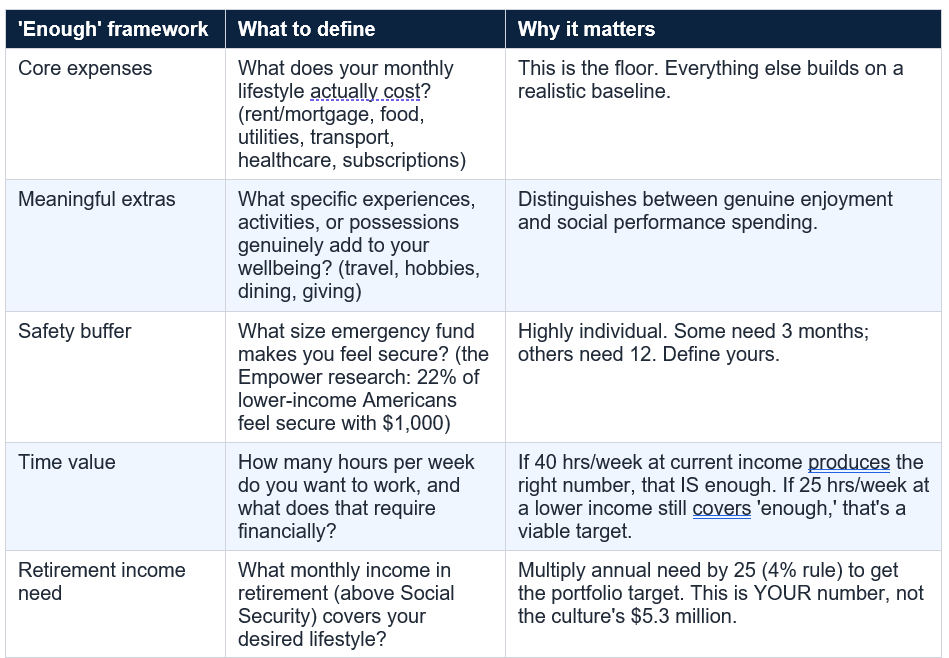
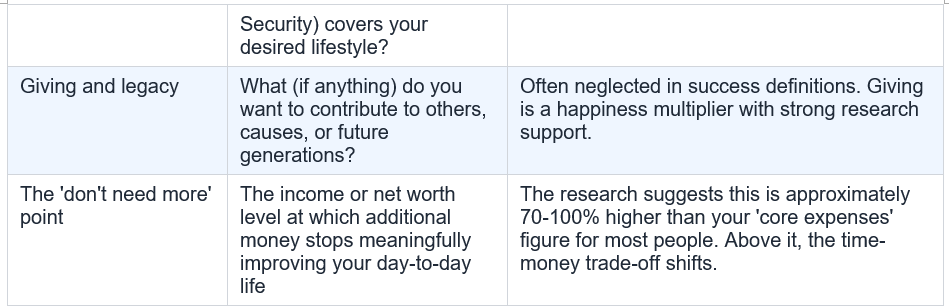
The starting point is expenses, not income. What does the life you genuinely want to live actually cost? Not the life you think you should want, not the life that would impress your peer group, but the life that, at the end of a week, produces the feeling that you are living well. This requires specificity. It means naming the actual activities, spaces, experiences, and relationships that constitute a good life for you — not as aspirations but as concrete present or near-term realities.
From that baseline, a financial sufficiency calculation becomes possible. If your desired lifestyle costs $6,000 per month and your current income is $7,500 per month, the question is not ‘how do I get to $270,000 per year?’ It is ‘how do I maintain and protect the $1,500/month margin, grow it modestly, and ensure it continues through retirement?’ That is a completely different financial planning problem from the accumulation race, and it is one with a clear, reachable answer.
The 4% withdrawal rule in retirement planning offers a useful frame. If you need $60,000 per year in retirement income (above any Social Security or pension income), a diversified portfolio of approximately $1.5 million supports that withdrawal indefinitely (at historical market return averages) without depleting the principal. $1.5 million is not $5.3 million. It is achievable for a meaningful portion of consistent savers over a career. The difference between the two is almost entirely the definition of how much retirement income you genuinely need, not a difference in financial sophistication or effort.
The result is a systematic upward distortion of the apparent financial reality of peer groups. Research on social comparison and wellbeing consistently finds that exposure to images of others’ apparent wealth and success reduces subjective financial wellbeing even when the observer’s actual financial situation has not changed. You can be in a better financial position than you were six months ago and feel worse about it because your reference point has drifted upward from social media consumption.
The specific mechanism is the moving goalpost. When the definition of financial success is driven by comparison rather than by personal need, it is structurally impossible to reach — because reaching it means you now exist in the social circle that defines the next level of success, and your reference group shifts accordingly. This is not a pessimistic observation; it is a description of how relative standards work when they are not anchored to something personal and stable. The anchor is the concept of enough.
The Empower research captures this dynamic precisely: 59% of Americans say society equates success with wealth, but only 27% privately believe wealth is the right measure. People are watching the external signal and feeling pressure from a definition they do not actually agree with. Social media is the mechanism by which that external signal enters the private experience of financial self-assessment on a daily basis.
The Real Question: A useful calibration exercise: think about the last time you felt genuinely financially satisfied or secure. What was happening? What specifically produced that feeling? The answer is almost never 'I had hit the $270,000 salary.' It is almost always a combination of specific, concrete, modest achievements: paid off that loan, saved enough for that trip, had a month where nothing unexpected hit the account. These are your actual success anchors. They are more reliable guides than any number generated by comparison.
The AOL 2026 consumer research found that 38% of US women report feeling anxious about money most days — and 24% of men report the same. The 21% who say debt keeps them up at night are describing a recognisable, physically felt experience of financial distress. Its opposite — the experience of not lying awake about money — is a profoundly undervalued form of financial success that the standard definitions almost never acknowledge.
The Empower research touches this with its finding that 63% of Americans define financial success as the ability to pay bills on time. This is not a consolation prize version of success. It is the foundation of financial wellbeing — the baseline from which everything else (saving, investing, giving, experiencing) becomes possible. A household that consistently meets its obligations, maintains a small savings buffer, and has no specific financial emergency looming has achieved something significant. The culture’s obsession with the $5.3 million net worth makes it impossible to experience that as success. But it is.
Morgan Housel, in The Psychology of Money, makes a version of this observation: financial success is not about maximising returns or hitting arbitrary net worth targets. It is about maintaining enough control over your time and circumstances that you do not feel trapped by your financial situation. The feeling of financial control — of knowing that your income exceeds your obligations, that you have a buffer against the unexpected, and that you are not compelled to do things you would not otherwise choose because of financial necessity — is the actual substrate of financial wellbeing.
The research is consistent across multiple studies: happiness, not wealth, is the primary benchmark of financial success for most people. Debt freedom, time control, security, and the ability to pay bills without anxiety define success for substantial portions of the population. The number that society associates with success is something most Americans neither privately endorse nor will realistically reach.
The practical implication is not that you should stop saving, stop investing, or lower your financial ambitions. It is that your financial ambitions should be calibrated to the life you actually want to live, not to the life a culturally aggregated definition tells you that you should want. A specific, honest, self-authored definition of financial success is not a consolation prize. It is the only definition that has any chance of producing the feeling of having arrived, because it is the only one whose goalpost you control.
Whose definition are you chasing? It is a question worth answering before the next decade of financial decisions. Not as therapy. As strategy.
According to Empower's 'Secret to Success' research, most Americans define financial success not primarily through wealth but through happiness. Fifty-nine per cent say the ability to spend money on things that bring them joy is the most important benchmark of success. Only 27% rank wealth as the highest measure. In practical terms, 63% say paying bills on time represents financial success, 52% say owning a home does, and 47% point to being able to afford experiences like travel and entertainment. The average salary Americans associate with the concept of being 'financially successful' is $270,000 per year, and the average net worth is $5.3 million — but only 43% define success as having a certain amount of money or assets. The findings suggest Americans have a more holistic, experiential definition of financial success than the cultural narrative implies. Sources: Empower research; NBC Washington; Benzinga; Audacy.
Why do so many Americans feel they'll never be financially successful?
Nearly half of Americans (47%) feel they will never achieve the level of financial success they are seeking, according to Empower research. The most likely explanation is the gap between the cultural definition of financial success — which emphasises high income and net worth thresholds most Americans cannot reach — and the individual's private sense of what success should mean. When success is defined by external benchmarks (the $270,000 salary, the $5.3 million net worth) rather than by personal circumstances and values, it becomes structurally difficult to reach and impossible to recognise when you do. The barriers Americans themselves identify include the economy (35%), income instability (30%), lack of financial knowledge (20%), and not setting clear financial goals (28%). The deeper issue may be that the goals being set are borrowed from social comparison rather than personal need. Sources: Empower research; Benzinga.
Is it better to be debt-free or to invest for wealth?
Research from 2026 consumer money mindset studies suggests that 34% of US consumers prioritise becoming debt-free before building wealth, and 33% define financial success as being debt-free regardless of assets. The 'debt-free first' approach is not universally correct in a financial planning sense: high-interest debt (credit cards, personal loans) should almost always be eliminated before investing because the guaranteed return from eliminating 20-25% interest exceeds any expected investment return. Low-interest debt (a mortgage at 3-5%) may not need to be eliminated before investing, because the expected long-term investment return can exceed the debt cost. The psychological and wellbeing case for debt freedom is significant regardless of the mathematical comparison: the AOL 2026 research found that debt is experienced as psychological weight, with 21% of lower-income consumers saying debt keeps them up at night. For many people, the peace of mind from debt freedom produces real wellbeing gains that pure return optimisation would miss. Not financial advice. Consult a qualified financial adviser. Sources: AOL consumer research 2026; general personal finance principles.
How does social media affect feelings of financial success?
Social media consistently distorts people's perception of their financial standing relative to peers. The mechanism is well-documented in behavioural science: when the lifestyles you see regularly are curated, self-selected highlights of apparent affluence — vacations, home renovations, cars, restaurants — without the context of the financial stress or debt that may have funded them, your reference point for what is normal shifts upward. Research on subjective financial wellbeing finds that exposure to apparent wealth in social peer groups reduces satisfaction with one's own financial situation even when the actual financial position has not changed. The Empower research captures a relevant data point: 59% of Americans say society equates success with wealth, while only 27% privately agree that wealth is the right measure of success. Social media is one of the primary channels through which the societal definition enters daily life and creates a gap between what you believe and what you feel pressured to pursue. The practical response is to audit your information diet: whose financial life are you regularly exposed to, and whose definition of success are they implicitly encoding for you?
How do I define financial success for myself?
A practical framework for defining financial success personally involves five steps. First, identify the source of your current implicit definition: what number or milestone are you treating as the threshold of success, and where did that number come from? If it came from social comparison or media rather than personal calculation, it may not serve you. Second, describe the life you want rather than the number: what does your ideal week look like, how many hours do you work, where do you live, what do you experience? Third, calculate what that described life actually costs annually. This is your income target — not the $270,000 cultural benchmark but your specific number. Fourth, define success as a set of ongoing conditions rather than a destination: consistently spending below income, maintaining a buffer, investing for the future, not carrying high-interest debt, giving if that matters. Fifth, build recognition into your plan: notice and mark financial milestones when they are reached. The Empower research and the 2026 consumer money mindset data consistently show that people who anchor their financial goals to personal circumstances and values rather than social comparison feel more financially successful at any income level. Not financial advice.
Table of Contents
- The Mismatch: Why 47% Feel They’ll Never ‘Make It’
- What the Research Actually Shows About Financial Success
- Where Your Current Definition Probably Came From
- The Society Tax: What You Pay When You Chase Someone Else’s Number
- The Debt-Free Shift: Why Subtraction Is the New Success
- The Time-Wealth Equation: What Gen Z Is Getting Right
- What ‘Enough’ Actually Looks Like (And How to Calculate Yours)
- The Comparison Trap: Social Media and the Moving Goalpost
- The Pay Bills, Eat Well, Sleep at Night Standard
- Building Your Own Financial Success Definition: A Framework
- Conclusion: Chase Your Number, Not Theirs
- Frequently Asked Questions
What Americans privately say success means
The reality gap: culture's benchmark vs median America
The 2026 shift: new definitions of success
The Mismatch: Why 47% Feel They’ll Never ‘Make It’
There is a specific financial anxiety that has very little to do with the actual numbers in your bank account. It is the nagging, persistent sense that whatever you have is not enough — not enough saved, not enough earned, not enough progress toward something that feels, frustratingly, like it keeps moving further away. If you have experienced this, you are not alone, and you are not broken. You are, most likely, chasing a definition of financial success that was never yours to begin with.The Empower research into how Americans define financial success produced a number that should stop everyone: 47% of Americans feel they will never achieve the level of financial success they are seeking. Nearly half. Not people who are destitute, not people who are in crisis — just people who have absorbed a definition of success they cannot reach, and are watching it from a distance and feeling like failures for not closing the gap.
The same research reveals the specific magnitude of the gap. The average salary that Americans consider ‘financially successful’ is $270,000 per year. The average net worth: $5.3 million. These are not numbers that most Americans will ever reach. The median US household income is approximately $80,000. The median net worth of Americans in their 50s is approximately $250,000. If success means $270,000 and $5.3 million, then the vast majority of Americans will spend their entire lives feeling like they have not made it — regardless of whether they have built a genuinely good, financially stable, and deeply satisfying life.
This is the mismatch. And the mismatch is not a personal failure. It is a structural feature of a financial culture that has outsourced the definition of success to someone else — to media, to advertising, to social comparison, to an inherited story about what ‘enough’ looks like that was never interrogated or chosen.
47% of Americans feel they will NEVER achieve the level of financial success they're seeking (Empower, 'Secret to Success' research). 37% currently consider themselves financially successful. Average 'successful' salary: $270,000/year. Average 'successful' net worth: $5.3 million. Median US household income: ~$80,000/year. The gulf between the average definition of success and the median American's reality is approximately 3.4x salary and 21x net worth. Yet 59% say happiness (not wealth) is their real benchmark. The contradiction is the insight. Sources: Empower research; Benzinga; NBC Washington; Audacy.
What the Research Actually Shows About Financial Success
The Empower research — which surveyed a large sample of Americans on their relationship with money, success, and happiness — produced findings that sit in direct tension with the cultural narrative most of us absorbed. When asked what financial success really means, respondents did not lead with net worth or income. They led with something much less quantifiable.Fifty-nine per cent of Americans say happiness is the most important benchmark of financial success — specifically, the ability to spend money on the things and experiences that bring them joy. Only 27% rank wealth as the highest measure. The gap between what people privately believe success means and what they perceive society believes is enormous: 59% say society equates success with wealth, 44% say society equates it with power, and 35% say society equates it with fame. Yet when asked what they personally value, just 6% say power matters to them at all.
The Charles Schwab Modern Wealth Survey produced a similar finding from a different angle. When asked what contributes most to their personal definition of wealth, survey respondents ranked happiness (45%) and amount of money (44%) in an essentially equal tie. Physical health came in at 37%, mental health at 32%, quality of relationships at 24%, and life experiences at 24%. Wealth, by any conventional definition, is barely the leading factor in how Americans define wealth.
In concrete terms, the Empower research found that financial success most commonly shows up as paying bills on time (63%), owning a home (52%), and being able to afford experiences like travel and entertainment (47%). Forty-two percent cite enjoying their job. Forty percent cite retiring at a goal age. These are not $5.3 million benchmarks. These are reachable, human-scale achievements — achievements that many Americans have already made without recognising them as success because they have been measuring against the wrong ruler.
The most important finding in the Empower research is not any individual percentage. It is the structural contradiction at the centre of the data: Americans say happiness is success; 59% also say society defines success as wealth; 47% feel they will never reach their own definition of success. The conclusion is that most people are not chasing their own definition. They are chasing the one they believe they are supposed to want. Understanding this distinction is the beginning of meaningful personal finance.
Where Your Current Definition Probably Came From
Almost nobody sits down at 25 and consciously selects a definition of financial success. It arrives from other directions, accumulated without much scrutiny. The family you grew up in, the neighbourhood you lived in, the schools you attended, the careers your parents had, the things that went unspoken about money in your household — all of these contribute to an internal framework about what ‘enough’ looks like and what financial failure or success feels like.For many people, the framework is generational comparison. Fifty per cent of Americans in the Empower research say they are or expect to be better off financially than their parents — and this is still used as a baseline measure of success. For generations where homeownership was achievable on a single income and retirement was funded by a defined-benefit pension, the comparison may feel like a rebuke. For younger generations navigating student debt, housing costs that have outpaced wage growth, and a shift from pensions to self-funded 401(k) accounts, matching the previous generation’s financial milestones requires different tools and a different mental model.
The media layer adds another filter. Financial media, wealth content, and investment content tend to platform the outliers — the early retirees, the millionaires who made it at 35, the founders who exited at 40. These are genuinely interesting stories. They are not, however, statistically representative of financial outcomes. Consuming them regularly without calibrating for their selection bias builds a distorted mental picture of what normal financial progress looks like at any age.
Then there is the income peer group. Research on subjective wellbeing consistently finds that people evaluate their financial situation not against an absolute standard but against the people around them. A household earning $120,000 in a neighbourhood where the median income is $200,000 feels behind. The same household in a neighbourhood where the median income is $60,000 feels ahead. Same money. Different emotional experience. The definition of financial success is doing almost all the work in both cases, and the definition is not self-authored.
The cost of an externally sourced financial success definition is not primarily financial. It is psychological. Running toward a target that is set by someone else — or by an aggregated cultural expectation of what success looks like — means the goalpost moves as you approach it. The person chasing $270,000 who reaches $270,000 often discovers that the relevant comparison group now earns $350,000. The person who reaches $5.3 million in net worth encounters a community where $10 million is the reference point. This is not cynicism. It is a documented feature of what psychologists call the hedonic treadmill applied to financial status. The solution is not to earn more. It is to redefine.
The Society Tax: What You Pay When You Chase Someone Else’s Number
There is a real financial cost embedded in pursuing the wrong definition of success, and it deserves to be named clearly. When your financial goals are set by social comparison rather than by genuine personal need and values, you tend to spend money on the wrong things, save for the wrong reasons, and experience the chronic low-grade dissatisfaction of a race in which the finish line keeps moving.The most tangible version of this is lifestyle inflation calibrated to peer groups rather than personal meaning. A household that buys a larger home than they need because the definition of success in their social circle includes a specific square footage is not allocating capital optimally. A professional who upgrades to a luxury car when a practical vehicle would serve the same function, because the luxury car signals the level of success they believe they need to project, is paying what might be called the society tax: the premium applied to purchases when social perception, rather than genuine utility, drives the decision.
The society tax shows up in different places at different income levels. At lower incomes, it may be the pressure to spend on branded items or to participate in social activities beyond one’s budget. At middle incomes, it is often private school fees, home renovation cycles, and vacation standards set by peer group rather than personal preference. At high incomes, it is the progression from adequate to aspirational to prestigious — a progression that has no natural endpoint and consumes an increasing fraction of income with diminishing returns on genuine wellbeing.
What makes this particularly costly is that the society tax is invisible in most financial plans. It does not appear as a line item. It is embedded in housing decisions, car decisions, clothing decisions, travel decisions — in the accumulated premium between what you would genuinely choose if nobody were watching and what you choose when the choice is visible to the peer group whose opinion shapes your definition of success.
The Debt-Free Shift: Why Subtraction Is the New Success
The 2026 consumer money mindset research (AOL, 2026) identified a significant shift in how Americans think about financial success, particularly among younger consumers. Thirty-three per cent of US consumers now define financial success as being debt-free — not having a specific net worth, not earning a specific income, but eliminating debt entirely. Thirty-four per cent say their ideal financial future begins with becoming debt-free first, with wealth-building coming later. The sequence is the insight: stability before scale. Relief before growth.This shift makes intuitive sense in a financial environment where the average American carries student loan debt, credit card balances, and a mortgage simultaneously. Debt is not merely a financial obligation. As the AOL research notes directly: ‘Debt is not merely a balance sheet item. It is psychological weight.’ The 21% of lower-income consumers who say debt keeps them up at night are not experiencing a financial problem in the abstract. They are living its physical and emotional texture every day.
Defining success as debt freedom is a meaningful reorientation of the financial goal-setting process. Instead of asking ‘how much do I need to accumulate?’ — a question with a moving answer driven by comparison — the debt-freedom framework asks ‘what obligations am I carrying that reduce my autonomy and increase my anxiety?’ and sets the goal as eliminating them. The answer to that question is concrete, measurable, and entirely personal. It does not depend on what anyone else earns or owns.
The fact that 22% of consumers earning under $50,000 say a $1,000 emergency fund would make them feel secure is another version of the same insight. For that population, success is not $5.3 million in net worth. It is $1,000 in a savings account that provides a buffer against the next unexpected car repair or medical bill. That is a valid, real, and meaningful financial success. The definition the broader culture offers makes it invisible.
The debt-free standard and the emergency fund standard are not lesser definitions of financial success. They are more precise ones. They answer the question 'what would make my financial life feel different tomorrow?' rather than 'what would make it feel successful according to a benchmark I absorbed from media?' Both are legitimate orientations. Only one of them produces a goal you might actually reach and recognise when you do.
The Time-Wealth Equation: What Gen Z Is Getting Right
Thirty-one per cent of Gen Z consumers say success means flexible work and control over their time (AOL 2026). This is a definition of financial success that older generations of financial thinking either did not name or actively dismissed: the value of time as a form of wealth.The conventional financial success narrative is built on capital accumulation: earn money, save money, invest money, accumulate enough to stop needing to earn money. Time is implicitly something you spend in the service of capital accumulation until the capital is sufficient to stop requiring your time. The Gen Z reorientation reverses the relationship: time is the primary resource, and money is valuable to the extent that it purchases or protects time.
This is not a naive position. It has a rigorous formulation: the utility of money is not linear. Research consistently finds that above approximately $75,000 to $100,000 in annual household income (a figure that varies by location and family size), additional income produces diminishing gains in day-to-day emotional wellbeing — though it continues to improve evaluative wellbeing (how satisfied people feel with their overall life when asked directly). The implication is that beyond a certain income threshold, trading time for money produces progressively less wellbeing return per dollar earned.
A person earning $90,000 with full schedule control, minimal commute, and the ability to structure their day around personal priorities may experience higher subjective financial wellbeing than a person earning $180,000 with a rigid schedule, long commute, and minimal flexibility — even if every standard financial metric would rank the latter as more successful. The definition of financial success that ignores the time dimension is missing more than half of the picture.
The Empower research found that 35% of Americans cite free time to pursue personal passions as a top indicator of financial success — equal to physical health and more common than any wealth metric. The definition of success is already incorporating time for a substantial portion of the population. The question is whether the financial plan reflects that priority.
What ‘Enough’ Actually Looks Like (And How to Calculate Yours)
The concept of ‘enough’ is more calculable than it is usually treated. Most personal finance content implicitly assumes that the answer to ‘how much is enough?’ is ‘more than you have now.’ But enough has an actual structure, and working through that structure is the central practice of defining your own financial success.The starting point is expenses, not income. What does the life you genuinely want to live actually cost? Not the life you think you should want, not the life that would impress your peer group, but the life that, at the end of a week, produces the feeling that you are living well. This requires specificity. It means naming the actual activities, spaces, experiences, and relationships that constitute a good life for you — not as aspirations but as concrete present or near-term realities.
From that baseline, a financial sufficiency calculation becomes possible. If your desired lifestyle costs $6,000 per month and your current income is $7,500 per month, the question is not ‘how do I get to $270,000 per year?’ It is ‘how do I maintain and protect the $1,500/month margin, grow it modestly, and ensure it continues through retirement?’ That is a completely different financial planning problem from the accumulation race, and it is one with a clear, reachable answer.
The 4% withdrawal rule in retirement planning offers a useful frame. If you need $60,000 per year in retirement income (above any Social Security or pension income), a diversified portfolio of approximately $1.5 million supports that withdrawal indefinitely (at historical market return averages) without depleting the principal. $1.5 million is not $5.3 million. It is achievable for a meaningful portion of consistent savers over a career. The difference between the two is almost entirely the definition of how much retirement income you genuinely need, not a difference in financial sophistication or effort.
The Comparison Trap: Social Media and the Moving Goalpost
The mechanism that most consistently disrupts personal financial success definitions in the current era is social comparison mediated by social media. The problem is not that social media shows affluent lifestyles — it is that it shows curated, self-selected, highlight-reel affluent lifestyles without the context that would allow accurate comparison. Nobody posts the monthly budget anxiety that preceded the luxury vacation. The vacation is the post. The financial stress is invisible.The result is a systematic upward distortion of the apparent financial reality of peer groups. Research on social comparison and wellbeing consistently finds that exposure to images of others’ apparent wealth and success reduces subjective financial wellbeing even when the observer’s actual financial situation has not changed. You can be in a better financial position than you were six months ago and feel worse about it because your reference point has drifted upward from social media consumption.
The specific mechanism is the moving goalpost. When the definition of financial success is driven by comparison rather than by personal need, it is structurally impossible to reach — because reaching it means you now exist in the social circle that defines the next level of success, and your reference group shifts accordingly. This is not a pessimistic observation; it is a description of how relative standards work when they are not anchored to something personal and stable. The anchor is the concept of enough.
The Empower research captures this dynamic precisely: 59% of Americans say society equates success with wealth, but only 27% privately believe wealth is the right measure. People are watching the external signal and feeling pressure from a definition they do not actually agree with. Social media is the mechanism by which that external signal enters the private experience of financial self-assessment on a daily basis.
The Real Question: A useful calibration exercise: think about the last time you felt genuinely financially satisfied or secure. What was happening? What specifically produced that feeling? The answer is almost never 'I had hit the $270,000 salary.' It is almost always a combination of specific, concrete, modest achievements: paid off that loan, saved enough for that trip, had a month where nothing unexpected hit the account. These are your actual success anchors. They are more reliable guides than any number generated by comparison.
The Pay Bills, Eat Well, Sleep at Night Standard
There is a definition of financial success that does not appear in any research survey but that describes the actual experience of financial wellbeing for most people who have it: pay bills on time without anxiety, eat food you actually like, and sleep at night without a specific financial worry keeping you awake.The AOL 2026 consumer research found that 38% of US women report feeling anxious about money most days — and 24% of men report the same. The 21% who say debt keeps them up at night are describing a recognisable, physically felt experience of financial distress. Its opposite — the experience of not lying awake about money — is a profoundly undervalued form of financial success that the standard definitions almost never acknowledge.
The Empower research touches this with its finding that 63% of Americans define financial success as the ability to pay bills on time. This is not a consolation prize version of success. It is the foundation of financial wellbeing — the baseline from which everything else (saving, investing, giving, experiencing) becomes possible. A household that consistently meets its obligations, maintains a small savings buffer, and has no specific financial emergency looming has achieved something significant. The culture’s obsession with the $5.3 million net worth makes it impossible to experience that as success. But it is.
Morgan Housel, in The Psychology of Money, makes a version of this observation: financial success is not about maximising returns or hitting arbitrary net worth targets. It is about maintaining enough control over your time and circumstances that you do not feel trapped by your financial situation. The feeling of financial control — of knowing that your income exceeds your obligations, that you have a buffer against the unexpected, and that you are not compelled to do things you would not otherwise choose because of financial necessity — is the actual substrate of financial wellbeing.
Building Your Own Financial Success Definition: A Framework
A personal definition of financial success needs four things: specificity, honesty, anchoring to values rather than comparison, and a mechanism for recognising success when it arrives. Here is a working framework for building one:- Step 1 — Audit your current definition: write down, without editing, the salary or net worth figure that you are implicitly treating as the threshold of financial success. Where did that number come from? Is it a round number (an arbitrary endpoint)? Is it what your parents earned, what your peers earn, what a financial article cited as the benchmark? Identifying the source is the first step to evaluating whether it serves you.
- Step 2 — Define the life, not the number: describe the weekly structure of the life you want to live. How many hours do you work? Where do you live? What do you eat, experience, and give? How much time do you spend on people and activities you value? This description is prior to money. The money goal is the funding requirement of this described life, not the reverse.
- Step 3 — Calculate the actual cost: once you have described the life, calculate what it costs annually. This is your genuine income target, not a socially normed benchmark. For many people, this number is significantly below $270,000 and the associated $5.3 million net worth. It may be below $80,000 in lower-cost areas. It may be $120,000 in an expensive city. It is yours, not the culture’s.
- Step 4 — Define success as a process, not a state: financial success is not a number you reach and then have. It is a set of habits and conditions that you either have or do not have right now: spending below your income, maintaining a buffer, not carrying high-interest debt, investing regularly for the future, giving if that matters to you. If these conditions are present, you are financially successful in the most meaningful sense. Not yet wealthy, perhaps. But successful.
- Step 5 — Build in recognition: most people who achieve financial milestones do not notice because they are already looking at the next one. Build specific moments of recognition into your financial plan. When the emergency fund reaches three months of expenses: notice it. When the last credit card is paid off: mark it. When the retirement account crosses a threshold that changes your future security: acknowledge it. Success that is not recognised does not produce wellbeing.
Conclusion
The gap between how Americans privately define financial success — happiness, free time, health, paying bills on time, experiences — and what the cultural narrative tells them success looks like — $270,000 a year, $5.3 million in net worth, a lifestyle that signals achievement to everyone watching — is not a small gap. It is a chasm. And 47% of Americans are living in that chasm, feeling like they have not made it, regardless of what they have actually built.The research is consistent across multiple studies: happiness, not wealth, is the primary benchmark of financial success for most people. Debt freedom, time control, security, and the ability to pay bills without anxiety define success for substantial portions of the population. The number that society associates with success is something most Americans neither privately endorse nor will realistically reach.
The practical implication is not that you should stop saving, stop investing, or lower your financial ambitions. It is that your financial ambitions should be calibrated to the life you actually want to live, not to the life a culturally aggregated definition tells you that you should want. A specific, honest, self-authored definition of financial success is not a consolation prize. It is the only definition that has any chance of producing the feeling of having arrived, because it is the only one whose goalpost you control.
Whose definition are you chasing? It is a question worth answering before the next decade of financial decisions. Not as therapy. As strategy.
Frequently Asked Questions
What do most Americans consider financially successful?According to Empower's 'Secret to Success' research, most Americans define financial success not primarily through wealth but through happiness. Fifty-nine per cent say the ability to spend money on things that bring them joy is the most important benchmark of success. Only 27% rank wealth as the highest measure. In practical terms, 63% say paying bills on time represents financial success, 52% say owning a home does, and 47% point to being able to afford experiences like travel and entertainment. The average salary Americans associate with the concept of being 'financially successful' is $270,000 per year, and the average net worth is $5.3 million — but only 43% define success as having a certain amount of money or assets. The findings suggest Americans have a more holistic, experiential definition of financial success than the cultural narrative implies. Sources: Empower research; NBC Washington; Benzinga; Audacy.
Why do so many Americans feel they'll never be financially successful?
Nearly half of Americans (47%) feel they will never achieve the level of financial success they are seeking, according to Empower research. The most likely explanation is the gap between the cultural definition of financial success — which emphasises high income and net worth thresholds most Americans cannot reach — and the individual's private sense of what success should mean. When success is defined by external benchmarks (the $270,000 salary, the $5.3 million net worth) rather than by personal circumstances and values, it becomes structurally difficult to reach and impossible to recognise when you do. The barriers Americans themselves identify include the economy (35%), income instability (30%), lack of financial knowledge (20%), and not setting clear financial goals (28%). The deeper issue may be that the goals being set are borrowed from social comparison rather than personal need. Sources: Empower research; Benzinga.
Is it better to be debt-free or to invest for wealth?
Research from 2026 consumer money mindset studies suggests that 34% of US consumers prioritise becoming debt-free before building wealth, and 33% define financial success as being debt-free regardless of assets. The 'debt-free first' approach is not universally correct in a financial planning sense: high-interest debt (credit cards, personal loans) should almost always be eliminated before investing because the guaranteed return from eliminating 20-25% interest exceeds any expected investment return. Low-interest debt (a mortgage at 3-5%) may not need to be eliminated before investing, because the expected long-term investment return can exceed the debt cost. The psychological and wellbeing case for debt freedom is significant regardless of the mathematical comparison: the AOL 2026 research found that debt is experienced as psychological weight, with 21% of lower-income consumers saying debt keeps them up at night. For many people, the peace of mind from debt freedom produces real wellbeing gains that pure return optimisation would miss. Not financial advice. Consult a qualified financial adviser. Sources: AOL consumer research 2026; general personal finance principles.
How does social media affect feelings of financial success?
Social media consistently distorts people's perception of their financial standing relative to peers. The mechanism is well-documented in behavioural science: when the lifestyles you see regularly are curated, self-selected highlights of apparent affluence — vacations, home renovations, cars, restaurants — without the context of the financial stress or debt that may have funded them, your reference point for what is normal shifts upward. Research on subjective financial wellbeing finds that exposure to apparent wealth in social peer groups reduces satisfaction with one's own financial situation even when the actual financial position has not changed. The Empower research captures a relevant data point: 59% of Americans say society equates success with wealth, while only 27% privately agree that wealth is the right measure of success. Social media is one of the primary channels through which the societal definition enters daily life and creates a gap between what you believe and what you feel pressured to pursue. The practical response is to audit your information diet: whose financial life are you regularly exposed to, and whose definition of success are they implicitly encoding for you?
How do I define financial success for myself?
A practical framework for defining financial success personally involves five steps. First, identify the source of your current implicit definition: what number or milestone are you treating as the threshold of success, and where did that number come from? If it came from social comparison or media rather than personal calculation, it may not serve you. Second, describe the life you want rather than the number: what does your ideal week look like, how many hours do you work, where do you live, what do you experience? Third, calculate what that described life actually costs annually. This is your income target — not the $270,000 cultural benchmark but your specific number. Fourth, define success as a set of ongoing conditions rather than a destination: consistently spending below income, maintaining a buffer, investing for the future, not carrying high-interest debt, giving if that matters. Fifth, build recognition into your plan: notice and mark financial milestones when they are reached. The Empower research and the 2026 consumer money mindset data consistently show that people who anchor their financial goals to personal circumstances and values rather than social comparison feel more financially successful at any income level. Not financial advice.

0 Comments Comments